

Your Complete Guide to Understanding RS-485 Communications
What is RS-485?
RS-485 (also known as EIA/TIA-485) is a robust communication standard that lets devices talk to each other over long distances. Think of it as a reliable messenger system for industrial equipment, building automation, and control systems.
Key Advantage: RS-485 can send signals up to 4,000 feet (1,200 meters) at speeds reaching 100 kbits/s, making it perfect for large facilities and industrial applications using the correct cable specifications and an example of which is pictured below:

Belden 9842 Has Two Twisted Pairs core colours can vary
22 AWG & Is Shielded Per Pair and also has a drain wire. One of the wires of the second pair will typically be used as "ground"
The fourth wire will be not-used.
How Does RS-485 Work?
The Smart Two-Wire System
RS-485 uses a clever approach called differential signalling. Instead of sending data on just one wire, it uses two wires working together:
-
Wire 1 carries the original signal first twisted pair.
-
Wire 2 carries an inverted (opposite) copy of the signal first twisted pair.
-
Wire 3 in the case of iSMA - Ground wire (0 V) for reference this is usually the third wire from the second pair. The fourth wire from the second pair is generally not used at all.
-
The shield works as a "drain" for any noise that could be picked up by the RS485 network.
-
Noise captured by the shield "will drain to ground"
-
However: Don't ground at the controller end, instead, ground at the furthest network point.
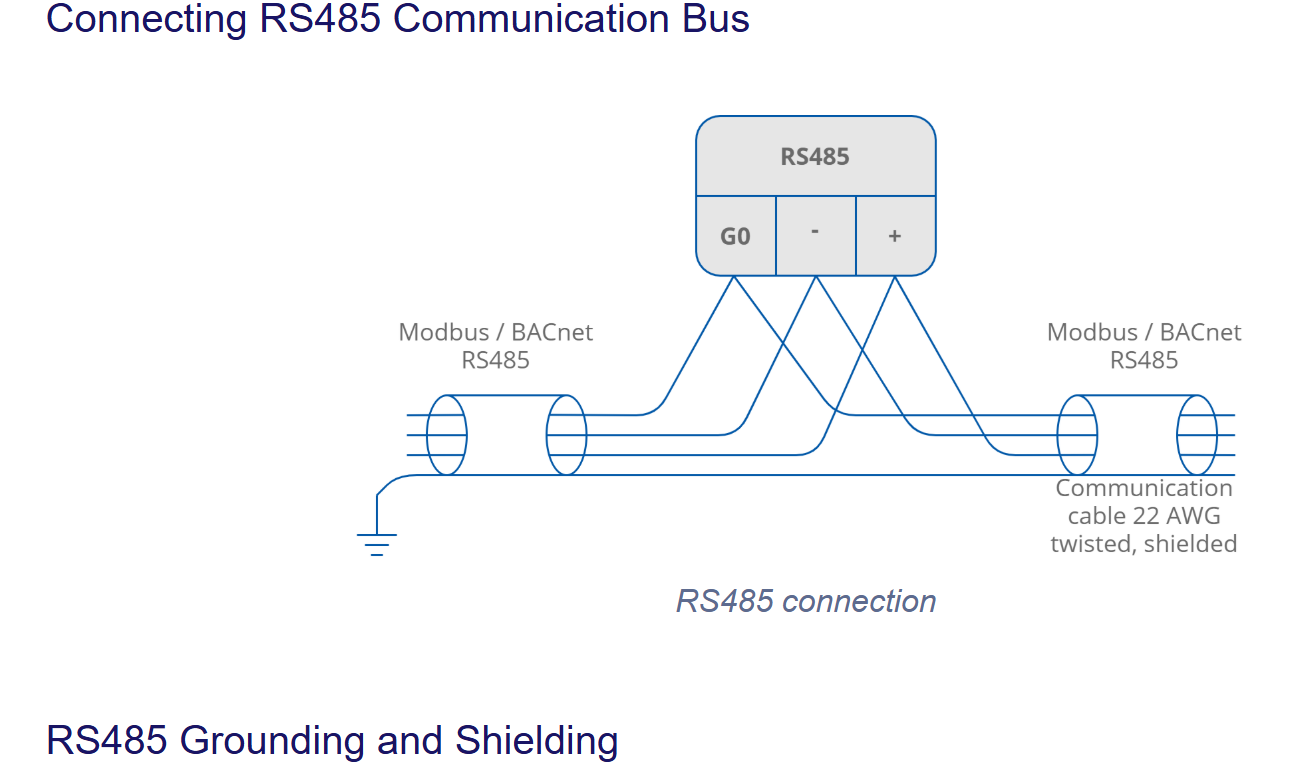
Why this matters: This dual-wire approach makes RS-485 incredibly resistant to electrical noise and interference, which is common in industrial environments, especially with VSD motors, relays, and other electrical equipment.
iSMA FCU Specific Tips?
RS-485 communication speeds would be typically set in line with the table shown below:
|
Baud Rate |
Approx. Max Distance |
|---|---|
|
9,600 bps |
~1200 m |
|
19,200 bps |
~1200 m (ideal) |
|
38,400 bps |
~600 m |
|
57,600 bps |
~400 m |
|
115,200 bps |
~100–200 m |
In the case of RS485 communicating iSMA FCU controllers, think of the max distance as the distance wired from the first controller to the next controller and so on. Typically the distance between controllers will be less than 100m in most cases.
Why 19,200 baud can slow and overload iSMA FCU RS‑485 networks
(and why 115,200 baud is explicitly recommended by iSMA)
At first glance at the table above, 19,200 baud appears to be a “safe” engineering choice because it is traditionally associated with longer RS‑485 distances. However, for daisy‑chained iSMA FCU controllers, this assumption is misleading and can actively degrade network performance.
Key point:
With iSMA FCUs, bandwidth, and not cable length, is the limiting factor.
1. The misunderstanding about “max distance” on FCU chains
The baud‑rate vs distance table shown above is technically correct for single continuous cable runs. However, iSMA FCU networks are not wired that way in practice.
In FCU applications:
-
Controllers are daisy‑chained
-
Typical spacing is 10–30 m between FCUs
-
Rarely exceeds 100 m between devices
-
Total electrical length is therefore broken up by transceivers at each controller
Because each FCU regenerates and boosts the signal, the practical distance limit is not the dominant constraint, provided:
-
120 Ω termination is correct
-
Shielding and grounding follow the manual
iSMA explicitly describes RS‑485 as a multi‑drop bus with short inter‑device distances, not a single 1200 m trunk.
2. Why 19,200 baud causes network congestion on iSMA FCUs
a) iSMA FCUs generate high protocol chatter
Each FCU typically exchanges multiple objects:
-
Temperature
-
Setpoint
-
Fan speed
-
Valve outputs
-
Occupancy
-
Alarms
-
COV‑based updates (BACnet MS/TP)
-
Frequent Modbus polling in retrofit installations
This creates:
-
High frame count
-
Short frame intervals
-
Many small packets rather than a few large ones
At 19,200 baud, the RS‑485 bus does not clear the frames quickly enough, so traffic queues up.
b) iSMA RS‑485 is half‑duplex so slow baud = longer bus occupation
RS‑485 (BACnet MS/TP or Modbus RTU):
-
Only one device can talk at a time
-
Token passing (MS/TP) or request/response (Modbus)
At 19,200 baud:
-
Each byte occupies the bus approximately 6× longer than at 115,200 baud.
-
Tokens circulate more slowly
-
Slaves respond later
-
Retries increase
This leads directly to:
-
Token loss (MS/TP)
-
Late replies (Modbus)
-
Increased error frames
iSMA controllers expose Error Frames counters precisely because this is a known issue on slow RS485 buses.
c) Slower baud rates increase electrical overlap problems
Counter‑intuitive but important:
-
Longer frame durations mean more overlap with EMI
-
Relay switching inside FCUs occurs while frames are “on the wire”
-
Reflections persist longer relative to data timing
This results in:
-
CRC errors
-
Re‑transmissions
-
Apparent “bus overload” symptoms
iSMA explicitly calls out EMI and reflection sensitivity in FCU RS‑485 guidance, stressing correct termination and fast signal clearance rather than low‑speed operation.
3. Why 115,200 baud works better on iSMA FCU networks
a) Higher baud = shorter electrical occupancy
At 115,200 baud:
-
Frames are completed ~6× faster
-
Tokens circulate quickly
-
Bus returns to idle sooner
-
Less exposure to noise per frame
This directly improves:
-
MS/TP token stability
-
Modbus polling consistency
-
Overall bus utilisation
b) Explicit iSMA recommendation (not a rule-of-thumb)
The iSMA‑B‑FCU Quick Start‑up Manual instructs installers to select baud rates up to 115,200 and does not recommend reducing baud for FCU networks unless distance forces it.
Additionally, the Hardware User Manual states:
-
Supported RS‑485 baud range: 2400 → 115,200
-
FCUs are designed for dense networks of controllers
-
Short segment wiring is assumed
In practice, iSMA technical documentation and field guidance align on:
115,200 baud is optimal for FCU daisy chains with short inter‑controller distances.
4. Practical rule (Forest Rock field guidance)
Use 115,200 baud when:
-
FCUs are <100 m apart
-
Network contains many FCUs (10+)
-
BACnet MS/TP is heavily used
-
Trend, COV, or fast polling is enabled
Only consider 19,200 baud when:
-
There is a single long RS‑485 trunk
-
Few devices are present
-
Update rates are very slow
-
Full termination and shielding are guaranteed
5. Summary
|
Baud Rate |
FCU Network Behaviour |
|---|---|
|
19,200 |
Slow token circulation, congested bus, retries, “noisy” behaviour |
|
115,200 |
Faster frame clearance, stable MS/TP, lower effective EMI exposure |
Bottom line:
19,200 baud does not “protect” iSMA FCU networks — it starves them.
115,200 baud aligns with how iSMA FCUs are architected and documented.
Follow these guidelines, and your RS-485 network will provide years of reliable service!
Other Resources & Customer Survey:
💬 Don't miss out! Follow the Forest Rock News channel on WhatsApp Click Here!
💬 We’d also love your feedback! Please take a moment to complete our quick Customer Survey
It only takes a minute and helps us serve you better!

IoT Devices for BMS, Automation & Smart Connectivity | Forest Rock