

Your Complete Guide to Understanding RS-485 Communications
What is RS-485?
RS-485 (also known as EIA/TIA-485) is a robust communication standard that lets devices talk to each other over long distances. Think of it as a reliable messenger system for industrial equipment, building automation, and control systems.
Key Advantage: RS-485 can send signals up to 4,000 feet (1,200 meters) at speeds reaching 100 kbits/s, making it perfect for large facilities and industrial applications using the correct cable specifications and an example of which is pictured below:

Belden 9842 Has Two Twisted Pairs core colours can vary
22 AWG & Is Shielded Per Pair and also has a drain wire. One of the wires of the second pair will typically be used as "ground"
The fourth wire will be not-used.
How Does RS-485 Work?
The Smart Two-Wire System
RS-485 uses a clever approach called differential signalling. Instead of sending data on just one wire, it uses two wires working together:
-
Wire 1 carries the original signal first twisted pair.
-
Wire 2 carries an inverted (opposite) copy of the signal first twisted pair.
-
Wire 3 in the case of iSMA - ground wire (0 V) for reference this is usually the third wire from the second pair. The fourth wire from the second pair is generally not used at all.
-
The shield works as a "drain" for any noise that could be picked up by the RS485 network and "drain" it to ground
Why this matters: This dual-wire approach makes RS-485 incredibly resistant to electrical noise and interference, which is common in industrial environments with motors, relays, and other electrical equipment.
Choosing the Right Cable
Not all cables are created equal! For reliable RS-485 communication, you need a twisted-pair cable with the right specifications.
|
Specification |
Details |
|
Wire Gauge |
22 or 24 AWG solid or stranded conductors |
|
Cable Type |
Twin Twisted-pair (shielded or unshielded) |
|
Shielding |
100% foil shield recommended for noisy environments |
|
Drain Wire |
24 AWG tinned copper drain wire for shield grounding |
|
Insulation |
Polypropylene or similar low-capacitance material |
Recommended Cable: Belden 9842 is a professional-grade choice, featuring 22 AWG stranded tinned copper conductors, individual shielding for each pair, and a compact design perfect for industrial installations.
Setting Up Your RS-485 Network
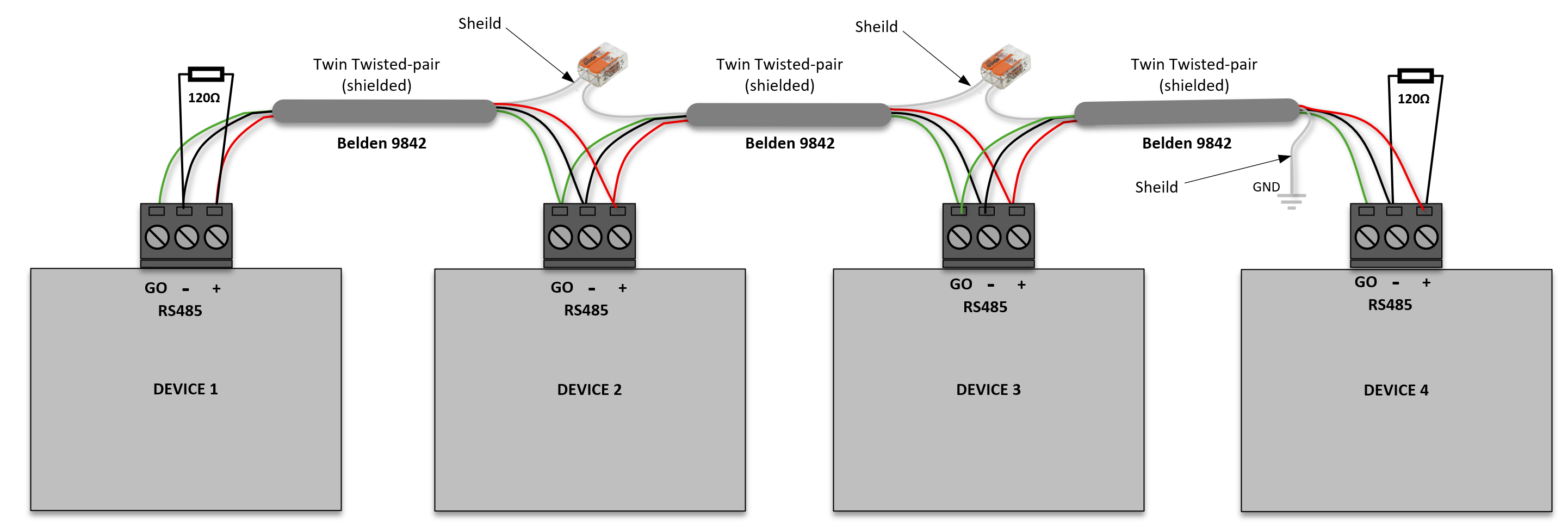
Network Termination (Critical!)
Proper termination prevents signal reflections that can corrupt your data. Think of it like stopping an echo in a tunnel.
Important Rule: Always terminate both ends of your RS-485 cable with a 120 Ω resistor. This is essential for reliable communication.
Grounding and Shielding Best Practices
Industrial environments are electrically noisy. Proper grounding and shielding protect your network from interference caused by motors, relays, contactors, and other electromagnetic sources.
Essential Protection Steps:
✓ Ground your control cabinet properly
✓ Connect cable shields to ground at one end only
✓ Use shielded twisted-pair cables in high-noise environments
✓ Install protective elements for electromagnetic switching devices
✓ Route signal cables away from power cables
Understanding Distance and Speed
The Distance-Speed Trade-off
RS-485 offers impressive performance, but there's a balance between how far you can go and how fast you can communicate.
|
Distance |
Maximum Speed |
|
20 meters (66 feet) |
5 Mbits/s |
|
100 meters (328 feet) |
1 Mbit/s |
|
1,200 meters (4,000 feet) |
100 kbits/s |
Quick Formula: Line length (meters) × Data rate (bits/second) ≤ 100,000,000
Example: A 20-meter cable allows speeds up to 5 Mbits/s, while a 1,200-meter cable limits you to about 83 kbits/s.
Twisted pair, 24 AWG, has a low capacitance (typically < 30 pF/ft) So with Proper 120 Ω termination at both ends the baud rate should be set in line with the table shown below:
|
Baud Rate |
Approx. Max Distance |
|---|---|
|
9,600 bps |
~1200 m |
|
19,200 bps |
~1200 m (ideal) |
|
38,400 bps |
~600 m |
|
57,600 bps |
~400 m |
|
115,200 bps |
~100–200 m |
Best practices if you need longer runs:
-
Drop baud rate to 9,600 or (4,800 at a push) or consider using RS‑485 extenders or Repeaters.
Common Applications
RS-485 is the backbone of many automation and control systems. Here's where you'll find it working hard:
-
Modbus networks for industrial automation and SCADA systems
-
BACnet MS/TP for building automation and HVAC control
-
CANopen networks in manufacturing and robotics
-
DMX512 for theatrical and architectural lighting control
-
Access control and security systems
Quick Reference Guide
|
Parameter |
Specification |
|
Maximum Distance |
1,200 meters (4,000 feet) |
|
Termination Resistor |
120 Ω at both ends of cable |
|
Signal Type |
Differential (balanced) transmission |
|
Wiring |
2 or 3 wire twisted-pair |
|
Common Protocols |
Modbus, BACnet MS/TP, CANopen, DMX512 |
Need More Help?
RS-485 is a proven, reliable technology when installed correctly. Remember the key points:
-
Use quality twisted-pair cable (preferably shielded)
-
Always terminate both ends with 120 Ω resistors
-
Implement proper grounding and shielding
-
Balance distance and speed based on your application needs
Follow these guidelines, and your RS-485 network will provide years of reliable service!
Other Resources & Customer Survey:
💬 Don't miss out! Follow the Forest Rock News channel on WhatsApp Click Here!
💬 We’d also love your feedback! Please take a moment to complete our quick Customer Survey
It only takes a minute and helps us serve you better!

IoT Devices for BMS, Automation & Smart Connectivity | Forest Rock