
LoRaWAN: A Beginner's Guide to Long-Range IoT Communication
LoRaWAN (Long Range Wide Area Network) is a wireless communication protocol designed for Internet of Things (IoT) devices that need to send small amounts of data over long distances while consuming minimal power. This guide will walk you through the fundamental concepts of LoRaWAN technology.
Understanding LoRaWAN System Architecture
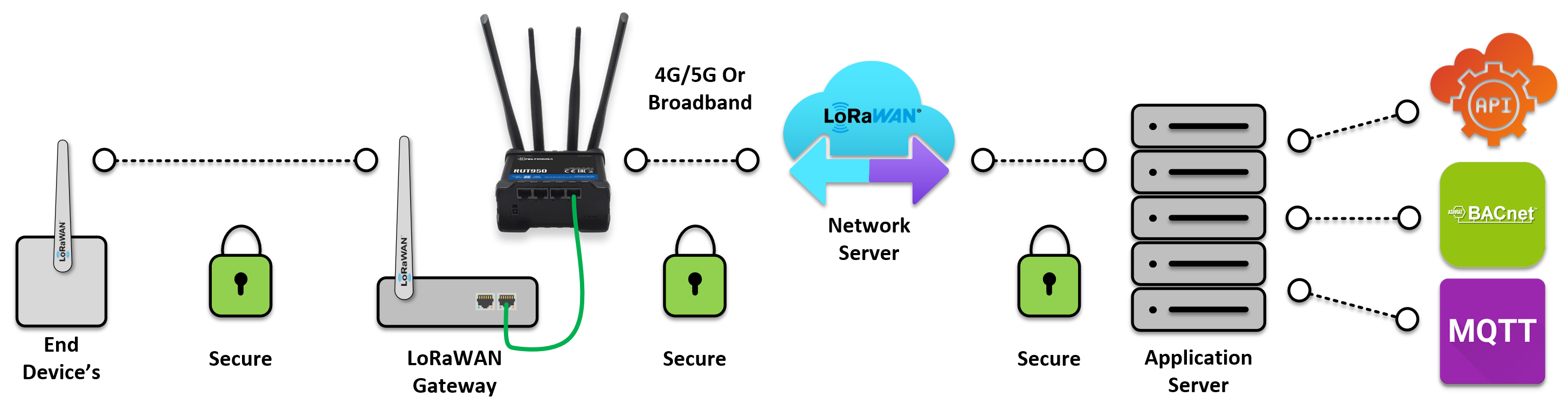
The LoRaWAN ecosystem consists of four main components that work together to enable communication between devices and applications.
End Devices
End devices are the sensors or actuators in your IoT network. These are battery-powered devices like temperature sensors, water meters, or GPS trackers that collect data from the physical world. They're designed to be extremely power-efficient, often running for years on a single battery. End devices communicate wirelessly using LoRa radio technology to transmit their data to nearby gateways.
Concentrators/Gateway
Gateways act as transparent bridges between end devices and the network server. A single gateway can receive messages from thousands of devices simultaneously, even if they're transmitting at the same time on the same frequency. Gateways are typically connected to the internet via WiFi, Ethernet, or cellular connections and forward all received messages to the network server without processing or filtering them.
Network Server
The network server is the brain of the LoRaWAN infrastructure. It manages the entire network by handling device authentication, security, data rate optimization, and message routing. The network server receives data from all gateways, removes duplicate messages (since multiple gateways might receive the same transmission), and forwards the data to the appropriate application server. It also manages downlink messages sent back to devices.
Application Server
The application server is where your IoT application lives. It processes the actual sensor data and presents it to end users or other systems. This is where you might see dashboards, trigger alerts, or integrate with other business systems. The application server communicates with end devices through the network server, sending commands or configuration updates when needed.
LoRaWAN Device Classes
LoRaWAN defines three device classes, each offering different trade-offs between power consumption and downlink communication capability.
Class A Devices
Class A devices are the most power-efficient option and represent the baseline for all LoRaWAN devices. After a device transmits data (an uplink), it opens two short receive windows to listen for any downlink messages from the server. If the server wants to send data to a Class A device, it must wait until the device transmits first. This makes Class A ideal for applications like periodic sensor readings where immediate downlink communication isn't critical. Most battery-powered sensors operate in Class A mode.
Class B Devices
Class B devices add scheduled receive windows to the Class A functionality. In addition to the receive windows after transmissions, these devices open extra listening windows at scheduled times synchronized with the network. This allows the server to send downlink messages at predictable times without waiting for an uplink. Class B devices consume more power than Class A but offer more predictable downlink latency. They're suitable for applications like street lighting control or actuators that need timely commands.
Class C Devices
Class C devices keep their receive windows open continuously except when transmitting. This provides the lowest latency for downlink communication since the server can send messages to the device at any time. However, Class C devices consume significantly more power and typically need to be mains-powered. These devices are ideal for applications requiring immediate responses, such as security systems or AC-powered actuators.
LoRa Radio Fundamentals
The physical layer of LoRaWAN uses LoRa (Long Range) modulation, which is based on chirp spread spectrum technology.
Radio Frequency Bands
LoRaWAN operates in unlicensed frequency bands that vary by region. In Europe, the primary band is 868 MHz, while North America uses 915 MHz, and Asia typically uses 923 MHz or other regional allocations. These sub-GHz frequencies are chosen because radio waves at these frequencies can travel long distances and penetrate buildings effectively. However, because these bands are unlicensed and shared with other technologies, LoRaWAN must follow regulations about transmission power and duty cycles.
Chirp Spread Spectrum (CSS)
Chirp Spread Spectrum is the modulation technique that gives LoRa its remarkable range and resilience to interference. A "chirp" is a signal that sweeps across a range of frequencies over time. LoRa encodes data by varying the starting point of these chirps. CSS allows multiple devices to transmit simultaneously on the same frequency without interfering with each other, and signals can be successfully decoded even when they're below the noise floor. This is why LoRa can achieve communication ranges of several kilometers even with low transmission power.
Spreading Factor
The spreading factor (SF) is a critical parameter that determines how data is encoded in LoRa transmissions, ranging from SF7 (fastest) to SF12 (slowest but most robust). A higher spreading factor means the signal is "spread" over a longer time period, making it more resistant to noise and interference and capable of reaching greater distances. However, this comes at the cost of longer transmission times and lower data rates. The network server dynamically adjusts the spreading factor for each device based on signal quality, optimizing the trade-off between range and battery life.
Data Rate Management
Data rate in LoRaWAN refers to how quickly data can be transmitted, typically measured in bits per second.
LoRaWAN supports multiple data rates depending on the spreading factor and bandwidth used. Lower spreading factors enable higher data rates but require better signal quality. The data rate affects how long it takes to transmit a message, which directly impacts battery life and network capacity. Each region has defined data rate tables that specify which combinations of spreading factor, bandwidth, and coding rate are allowed.
Adaptive Data Rate (ADR)
Adaptive Data Rate is an intelligent mechanism where the network server optimizes each device's transmission parameters. When a device consistently achieves good communication quality, the network server instructs it to increase its data rate (lower spreading factor) and potentially reduce transmission power. This saves battery life and frees up airtime for other devices. Conversely, if communication quality degrades, the network increases the spreading factor to maintain reliable connectivity. ADR works best for stationary devices with stable radio conditions and can be disabled for mobile devices that experience rapidly changing signal environments.
Network Types
LoRaWAN networks can be deployed in two fundamental configurations.
Public LoRaWAN networks are operated by telecommunications companies or specialized IoT network providers. These networks offer coverage across cities, regions, or even entire countries, allowing you to deploy devices without building your own infrastructure. You typically pay a subscription fee per device or per message. Public networks are ideal for wide-area deployments, mobile applications, or when you want to quickly prototype without infrastructure investment.
Private LoRaWAN networks are built and operated by organizations for their own use. You deploy your own gateways and network servers, giving you complete control over coverage, capacity, security, and data. Private networks make sense when you need coverage in specific locations not served by public networks, require guaranteed service levels, have data privacy concerns, or have a large number of devices that make private infrastructure more cost-effective than public network subscriptions. Many organizations use a hybrid approach, deploying private networks where they need guaranteed coverage while relying on public networks for extended reach.
LoRaWAN's flexibility in device classes, adaptive communication parameters, and deployment options makes it an excellent choice for a wide range of IoT applications, from smart agriculture and asset tracking to smart cities and industrial monitoring. By understanding these fundamental concepts, you can make informed decisions about how to design and deploy your own LoRaWAN solutions.