

Welcome to Your BMS Learning Journey
Every Building Management System, from a small retail unit to a major hospital, relies on one simple principle:
Inputs provide information. Outputs make things happen.
Understanding how these signals work is the first step towards becoming a successful BMS engineer.
Whether you're:
-
New to the industry
-
Moving from electrical engineering into controls
-
Working in facilities management
-
Supporting smart building projects
-
Looking to develop your Niagara skills
This article introduces the core concepts used in almost every Building Management System worldwide.
By the end of this article, you'll understand how controllers monitor building conditions, make decisions, and control plant equipment using standard BMS inputs and outputs.
What You'll Learn
-
The difference between Analog and Digital points
-
How BMS controllers process information
-
How inputs and outputs interact
-
How to read a basic I/O schedule
-
Where these skills fit into a BMS career
Why Every BMS Engineer Needs This Knowledge
Inputs and outputs are the foundation of every control strategy.
When troubleshooting a heating fault, commissioning an AHU, integrating a chiller, or estimating a new project, engineers must understand:
✅ What information the controller is receiving
✅ What commands the controller is sending
✅ How field devices interact with the BMS
✅ How to interpret I/O schedules and control drawings
These skills are used daily by:
-
Service Engineers
-
Commissioning Engineers
-
Project Engineers
-
Applications Engineers
-
Technical Support Engineers
-
Energy Managers
Mastering I/O fundamentals will make every aspect of BMS engineering easier.
Real-World Example: Temperature Control
A room temperature sensor measures 22°C.
Input
AI-1 Room Temperature Sensor
The BMS receives the temperature value.
Logic
The controller compares the room temperature against the setpoint.
Output
AO-1 Heating Valve Position
The controller opens or closes the valve to maintain comfort.
This simple sequence demonstrates the fundamental principle behind virtually every BMS application.
Input → Decision → Output
Understanding this chain is the key to understanding any control system.
Sample BMS I/O Points Schedule

Did You Know?
A modern hospital BMS may contain:
-
50,000+ control points
-
Hundreds of controllers
-
Multiple protocols including BACnet, Modbus and KNX
-
Advanced analytics platforms
-
Energy optimisation systems
Every one of these systems ultimately relies on the same Input and Output principles covered in this module.
Taking Your Learning Further
This PDF module introduces the core principles used throughout the Building Management Systems industry. Engineers wishing to develop their knowledge further may explore structured training and certification programmes covering Niagara engineering, advanced integrations, analytics, and smart building technologies.
Download The Training Module PowerPoint
BMS-101-Training - Forest Rock - Project Base Camp.pdf
A Typical BMS Career Development Path
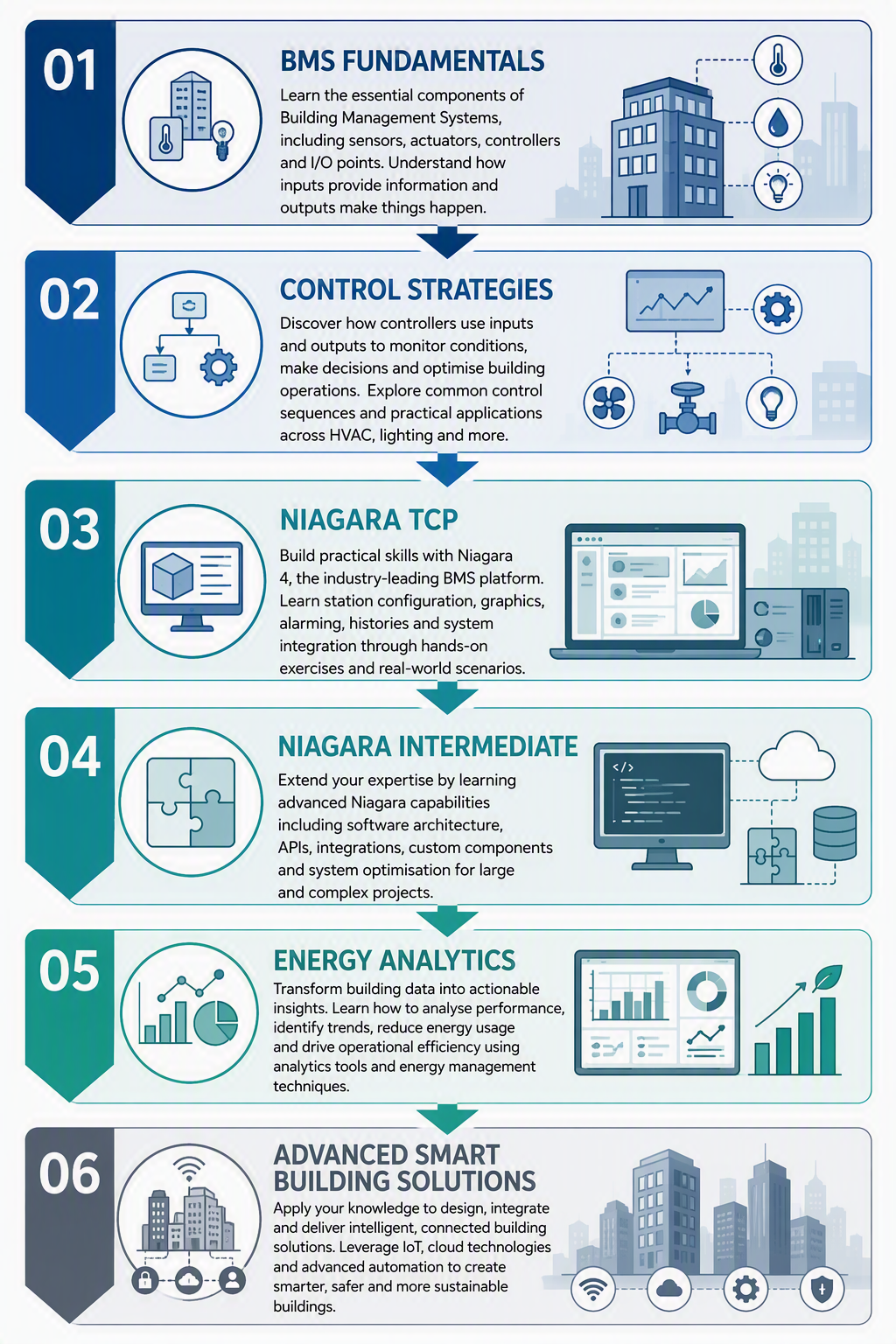
While every engineer follows a different route into the industry, most technical development follows a similar progression:
There is no single route into the BMS industry.
Many successful engineers begin their careers in:
-
Electrical engineering
-
HVAC
-
Facilities management
-
Control systems
-
IT and networking
-
Energy management
Regardless of background, most engineers build their knowledge through a combination of practical experience, mentoring, and technical training.
From BMS Engineer to Niagara Specialist
Most engineers begin by learning how to configure stations, create graphics, manage alarms, and integrate systems.
As projects become larger and more complex, engineers are often required to:
-
Integrate cloud services
-
Connect enterprise applications
-
Create reusable engineering solutions
-
Extend platform functionality
-
Improve system scalability
These advanced skills often become important as engineers move from day-to-day station engineering into enterprise-scale smart building projects.
Why It Matters
As buildings become more connected, engineers are increasingly expected to integrate Niagara with external systems, enterprise platforms, analytics tools, and custom applications. Understanding how Niagara can be extended allows engineers to solve challenges that are difficult or impossible using standard configuration alone.
Skills You'll Encounter as a BMS Engineer
As your experience grows, you'll become familiar with technologies such as:
-
BACnet
-
Modbus
-
KNX
-
MQTT
-
Energy Analytics
-
HVAC Control Strategies
-
Trend Analysis
-
Alarm Management
-
Smart Building Integration
-
Cloud Connectivity
Where Do These Skills Lead?
The concepts covered in this module form the foundation of all BMS engineering. Once engineers understand inputs, outputs, control logic, alarms, trends, and system architecture, they can begin working with larger and more complex smart building systems.
As projects evolve, engineers are increasingly required to integrate multiple protocols, connect cloud services, analyse energy performance data, and develop scalable solutions across multiple sites.
Beyond TCP: Developing Advanced Niagara Skills
Engineers who have completed Niagara TCP often encounter challenges that extend beyond standard station engineering.
Typical examples include:
-
Enterprise integrations
-
REST and web service connectivity
-
Reusable engineering frameworks
-
Custom modules and components
-
Scalable multi-site architectures
These topics form part of the broader Niagara ecosystem and are commonly encountered on healthcare, commercial, education, and critical-environment projects.
Engineers wishing to explore these areas further may find value in the Niagara 4 Intermediate Technical Certification programme, which examines these advanced concepts in greater depth.
Key Takeaway
Every BMS application, from a small heating controller to a large hospital campus, relies on the same fundamental principle:
Input → Decision → Output
Understanding these concepts provides the foundation for everything that follows in BMS engineering, including control strategies, analytics, integrations, energy management, and smart building technologies.
Whether you're just starting your journey or looking to expand your knowledge, mastering the fundamentals will make every future skill easier to learn.
For further technical resources and information on Niagara Framework technologies, visit the Forest Rock website.


IoT Devices for BMS, Automation & Smart Connectivity | Forest Rock