

Understanding the Layers of Modern Building Intelligence
By Paul Martin
Learning Objectives
After reading this article, you will be able to:
-
Understand the different architectural layers that make up a modern smart building.
-
Recognise the distinction between building control, data collection, analytics and business intelligence.
-
Identify the role of the Building Management System (BMS) within a broader smart building ecosystem.
-
Understand how open protocols, APIs and integration platforms enable interoperability between building systems.
-
Evaluate how analytics, machine learning and energy management platforms transform operational data into actionable insight.
-
Appreciate why modern smart building projects increasingly focus on business outcomes and performance improvement rather than control systems alone.
Category: Building Management Systems (BMS)
Sub-Category: Smart Buildings & Digital Transformation
Estimated Reading Time: 8-10 Minutes
CPD Value: 0.15 Hours (Approximately)
Rethinking the Core of the Smart Building
"For many years the Building Management System has been regarded as the heart of the smart building. While this remains true from a controls perspective, modern smart buildings increasingly rely on data, analytics and business intelligence that extend beyond the traditional boundaries of the BMS."
This viewpoint reflects a traditional perspective that has shaped the building controls industry for decades. Historically, it was difficult to argue otherwise. The BMS was often the most intelligent system within a building, responsible for controlling HVAC systems, managing alarms, scheduling plant and providing operators with visibility of building services.
Today, however, the smart building landscape looks very different.
Modern buildings generate vast amounts of operational data from energy meters, occupancy systems, environmental sensors, lighting controls, room booking platforms, access control systems and countless connected devices. At the same time, building owners increasingly demand measurable outcomes rather than simply effective control.
Questions such as:
-
How energy efficient is my building?
-
Is the estate achieving its Net Zero objectives?
-
Which buildings are underperforming?
-
How effectively is space being utilised?
-
Are optimisation programmes delivering results?
cannot be answered by control systems alone.
This does not diminish the importance of the BMS. Far from it.
The BMS remains one of the most important systems within a building. However, in a modern smart building, it increasingly forms part of a wider architecture that combines operational technology, data, analytics and business intelligence.
A smart building should therefore be viewed not as a single system, but as an ecosystem of interconnected layers working together to improve performance.
The BMS Controls Assets
The primary role of a BMS is operational control.
Typical responsibilities include:
-
HVAC control
-
Plant sequencing
-
Alarm management
-
Scheduling
-
Environmental monitoring
-
Equipment optimisation
These functions remain fundamental to the effective operation of commercial buildings.
Without a BMS, many facilities would struggle to achieve acceptable levels of comfort, efficiency and reliability.
However, controlling equipment is not the same as understanding building performance.
A BMS may successfully start and stop plant, maintain temperature setpoints and respond to alarms, while the building itself continues to consume more energy than expected or fails to meet comfort, sustainability or operational objectives.
This distinction is becoming increasingly important within both new-build and retrofit projects.
Historically, controls specifications focused on ensuring that building services operated correctly. Today, many consultants and building owners are equally concerned with performance outcomes.
Buildings are increasingly assessed against criteria such as:
-
Energy Use Intensity (EUI)
-
Carbon reduction targets
-
Occupant comfort
-
Indoor Environmental Quality (IEQ)
-
ESG commitments
-
Sustainability objectives
Meeting these requirements demands more than control logic. It requires measurement, analytics, benchmarking and continuous performance verification.
The industry is therefore moving beyond asking:
"Is the plant operating correctly?"
and towards asking:
"Is the building performing as intended?"
Smart Buildings Need More Than Control
Building owners today face operational challenges that extend well beyond traditional controls.
Many organisations now require:
-
Energy analytics
-
Carbon accounting
-
ESG reporting
-
Space utilisation analysis
-
Occupancy intelligence
-
Predictive maintenance
-
Estate-wide benchmarking
-
Tenant reporting
-
Sustainability reporting
Most of these functions sit above the traditional control layer.
For example, a correctly controlled chiller plant might still be operating inefficiently compared to similar buildings elsewhere within the estate.
Similarly, a ventilation system may be functioning exactly as programmed, yet serving a floor that is only occupied at 30% capacity.
Understanding these situations requires context.
It requires the ability to bring together multiple data sources and convert information into insight.
This is where modern smart building platforms begin to differentiate themselves from traditional building control systems.
Data Creates Building Intelligence
Historically, many building systems operated independently.
Examples include:
-
Building Management Systems
-
Energy Metering
-
Lighting Controls
-
Access Control Systems
-
Room Booking Platforms
-
Security Systems
-
Occupancy Monitoring
-
Environmental Sensors
Viewed individually, each system provides only part of the picture.
When combined, however, they reveal relationships that would otherwise remain hidden.
Consider the following example:
A BMS reports that an air handling unit is operating normally.
An occupancy system indicates that the area served by the unit is only partially occupied.
An energy management platform reveals that the AHU uses substantially more energy than equivalent systems elsewhere.
Individually, these data points offer limited value.
Together, they provide actionable intelligence.
The opportunity is no longer simply to control equipment efficiently. The opportunity is to understand how building systems contribute to overall business and operational outcomes.
Open Integration Is Essential
One of the defining characteristics of modern smart buildings is interoperability.
Building owners rarely have the luxury of starting with a blank sheet of paper. Most estates contain equipment from multiple manufacturers installed over many years.
As a result, successful smart buildings depend upon technologies that enable systems to work together.
Examples include:
-
BACnet
-
Modbus
-
KNX
-
MQTT
-
REST APIs
-
Web Services
-
Enterprise Integration Platforms
These technologies allow information to move freely between systems, creating a unified view of building performance.
Rather than creating new silos, modern smart building strategies focus on connecting previously isolated data sources into a cohesive operational platform.
LoRaWAN and Modern Sensing
The growth of wireless sensing technologies is accelerating the shift towards data-driven buildings.
Historically, adding additional measurement points often required:
-
New cabling
-
Additional BMS input modules
-
Control panel modifications
-
Significant installation costs
Today, wireless technologies such as LoRaWAN allow thousands of sensors to be deployed quickly, economically and with minimal disruption.
These devices can monitor:
-
Temperature
-
Humidity
-
Air quality
-
Occupancy
-
CO₂
-
Door status
-
Asset condition
Some of this information may be used directly within control strategies.
Other datasets may support analytics, reporting and optimisation initiatives without ever being connected directly to the BMS.
Both approaches have value.
The objective should not be to force all data into a single system, but to ensure data is available wherever it can deliver the greatest operational benefit.
The Building Performance Layer
The greatest opportunities for improvement increasingly exist above the control layer.
Platforms such as N4 Energy Manager demonstrate this shift.
They do not replace the BMS.
Instead, they provide:
-
Energy benchmarking
-
Ranking analysis
-
Anomaly detection
-
Data integrity monitoring
-
Degree day analysis
-
Estate-wide reporting
-
Continuous commissioning support
These capabilities help answer the questions that most building owners actually care about:
-
Why is this building consuming more energy than expected?
-
Which site is performing best?
-
Which assets are deteriorating?
-
Where should capital investment be directed? The Building Performance Layer
The greatest opportunities for improvement increasingly exist above the control layer.
Platforms such as N4 Energy Manager demonstrate this shift.
They do not replace the BMS.
Instead, they provide:
-
Energy benchmarking
-
Ranking analysis
-
Anomaly detection
-
Data integrity monitoring
-
Degree day analysis
-
Estate-wide reporting
-
Continuous commissioning support
These capabilities help answer the questions that most building owners actually care about:
-
Why is this building consuming more energy than expected?
-
Which site is performing best?
-
Which assets are deteriorating?
-
Where should capital investment be directed?
-
Are energy reduction initiatives working?
-
The Future Smart Building Architecture
The future smart building is unlikely to have a single "core".
Instead, it will comprise multiple interconnected layers.
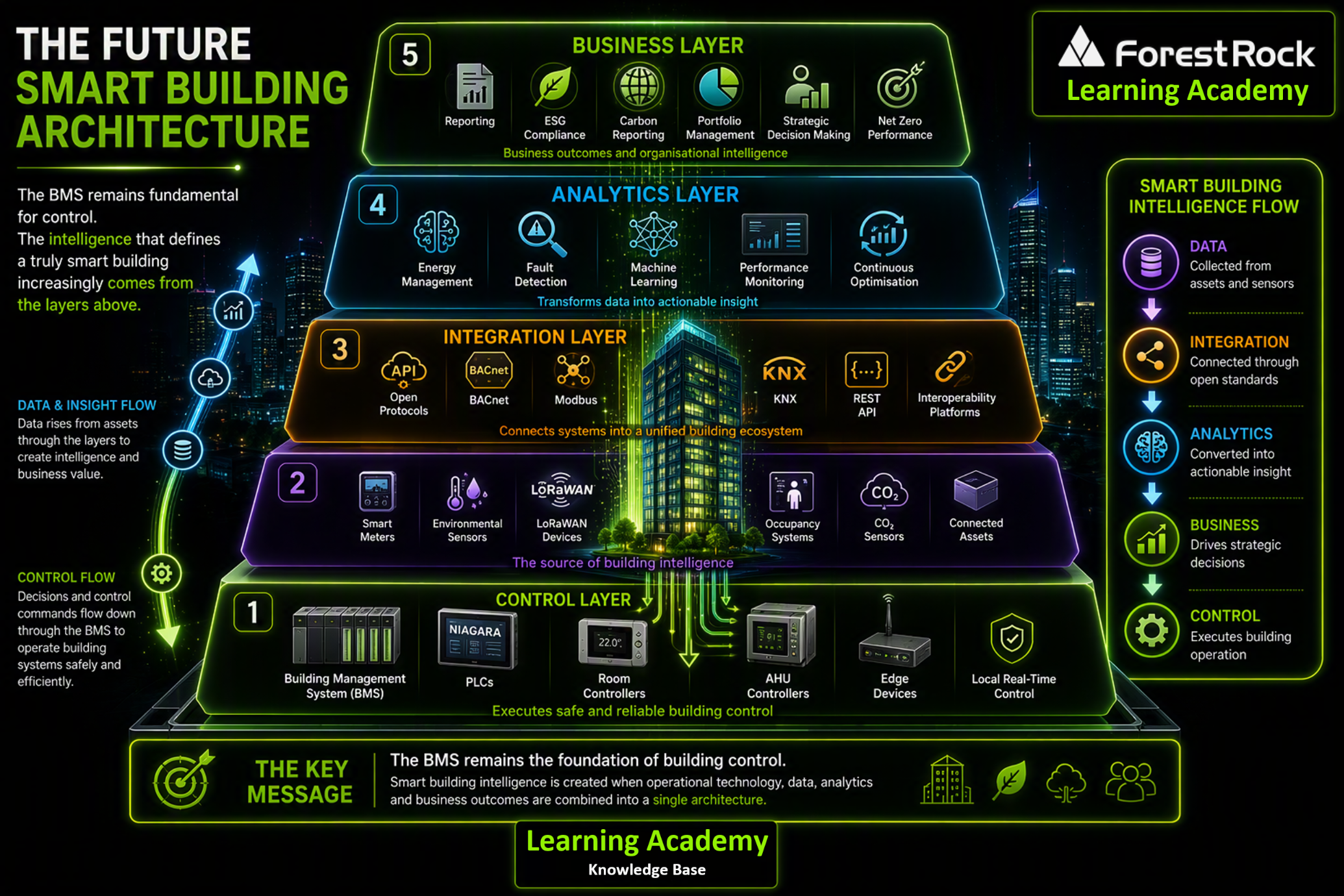
Business Layer
Reporting, ESG compliance, portfolio management and strategic decision-making.
Analytics Layer
Energy management, fault detection, machine learning and performance monitoring.
Integration Layer
Open protocols, APIs and interoperability platforms.
Data Layer
Meters, sensors, LoRaWAN devices, occupancy systems and connected assets.
Control Layer
BMS, PLCs, room controllers and edge devices.
Each layer performs a distinct function.
The control layer ensures buildings operate safely and effectively.
The data layer provides visibility.
The integration layer connects systems.
The analytics layer converts information into actionable insight.
The business layer supports decision-making and organisational objectives.
The BMS remains fundamental because it executes control.
However, the intelligence that defines a truly smart building increasingly emerges from the interaction between all of these layers rather than from any single system.
Conclusion
The Building Management System remains one of the most important technologies within a building and continues to provide the operational foundation upon which efficient facilities depend.
However, the modern smart building extends far beyond the control layer.
True building intelligence is created when operational technology, data, integration platforms, analytics and business objectives work together to deliver measurable outcomes.
The smartest buildings are not necessarily those with the most sophisticated control systems.
They are the buildings that continuously learn from operational data, transform information into insight and use that insight to improve performance over time.
The BMS therefore remains a critical foundation for smart buildings.
But smart building success increasingly depends on what happens above the control layer.
Further Reading
This article focuses on the evolution of smart building architecture and the role of the BMS within a wider digital ecosystem.
For a deeper understanding of how building performance can be measured, benchmarked and improved, see:
Closing the Building Performance Gap: Using Smart Controls and Energy Analytics to Improve Performance
This companion article explores BS EN 15232 performance classes, energy analytics, benchmarking and continuous optimisation strategies for modern buildings.
If you need more help:
Then why not contact our sales or support team.

sales@forestrock.co.uk or support@forestrock.co.uk
Learn | Integrate | Innovate
Welcome to the Forest Rock Learning Academy.
Real Knowledge. Real Engineers. Real Solutions.