

Forest Rock's Strategy for Transforming Data Silos into Intelligent Building Ecosystems
By Paul Martin
Executive Summary
The building industry is facing a fundamental challenge.
Over the last three decades, buildings have become increasingly digital, yet many projects continue to be delivered as collections of individual systems rather than integrated operational platforms. Building Management Systems, lighting controls, energy metering, access control, fire systems, EV charging infrastructure, renewable energy assets and environmental monitoring systems are often specified, installed and maintained independently.
Each system generally achieves its intended purpose. However, the outcome is frequently a fragmented estate of disconnected technologies, proprietary databases, duplicate infrastructure and isolated cloud services.
The result is not a lack of data.
The result is a lack of intelligence.
Modern buildings generate more operational information than ever before, but much of that information remains trapped within vendor-specific ecosystems, inaccessible to the wider operational, sustainability and business objectives of the organisation.
Forest Rock believes a different approach is required.
Rather than creating larger technology stacks, building owners should focus on creating open, adaptable data architectures that allow best-of-breed technologies to work together as part of a unified ecosystem.
This requires:
-
BACnet as the operational integration backbone
-
LoRaWAN for scalable sensor deployment
-
MQTT for intelligent data distribution
-
IP networking as the common communications layer
-
Open semantic tagging and data modelling
-
Edge computing for local resilience
-
Cloud services for advanced analytics and optimisation
The goal is not platform standardisation.
The goal is data standardisation.
The organisations that succeed in the next generation of smart buildings will not necessarily have the most technology.
They will have the most usable data.
Buildings Should Be Data Platforms
Historically, building projects have been designed around equipment.
Questions such as:
-
Which Building Management System should be specified?
-
Which controls contractor should be appointed?
-
Which lighting controls are required?
-
Which energy meters should be installed?
have traditionally dominated building design discussions.
While these remain important decisions, they no longer determine the long-term success of a building.
For building owners and operators, the real challenge is not controlling equipment. The challenge is understanding how the building performs over time and using that information to improve outcomes.
Modern buildings generate large amounts of operational data from:
-
HVAC systems
-
Lighting controls
-
Energy meters
-
Renewable energy systems
-
Occupancy monitoring
-
Environmental sensors
-
Access control systems
-
EV charging infrastructure
-
Workplace technologies
The value of this data is not created at the point of collection.
The value is created when data helps answer business questions such as:
-
Why is one building consuming more energy than another?
-
Why are occupants complaining about comfort?
-
Which assets are likely to fail?
-
Which areas are under-utilised?
-
Where can carbon emissions be reduced?
-
How can maintenance budgets be prioritised?
A single sensor may support multiple objectives.
For example, a temperature sensor installed to support HVAC control may also contribute to:
-
Occupant comfort analysis
-
Energy optimisation
-
Carbon reporting
-
Regulatory compliance
-
Predictive maintenance
-
AI-driven analytics
This is why modern buildings should be viewed as data platforms rather than collections of independent systems.
The Building Owner Perspective
Forest Rock believes one question should be at the centre of every smart building project:
"Will the owner still be able to use this data in ten years' time?"
Too many projects focus on the commissioning phase and not enough on the operational lifecycle that follows.
Building systems will be upgraded.
Software platforms will change.
Manufacturers may be acquired or disappear altogether.
Data, however, should remain useful throughout the life of the building.
A successful architecture is therefore one that preserves:
-
Data ownership
-
System interoperability
-
Vendor flexibility
-
Future technology choice
The objective should not be to create dependence on a particular product or supplier.
The objective should be to create an environment in which future technologies can be adopted without replacing the entire infrastructure.
The Forest Rock Open Architecture Guidlines
-
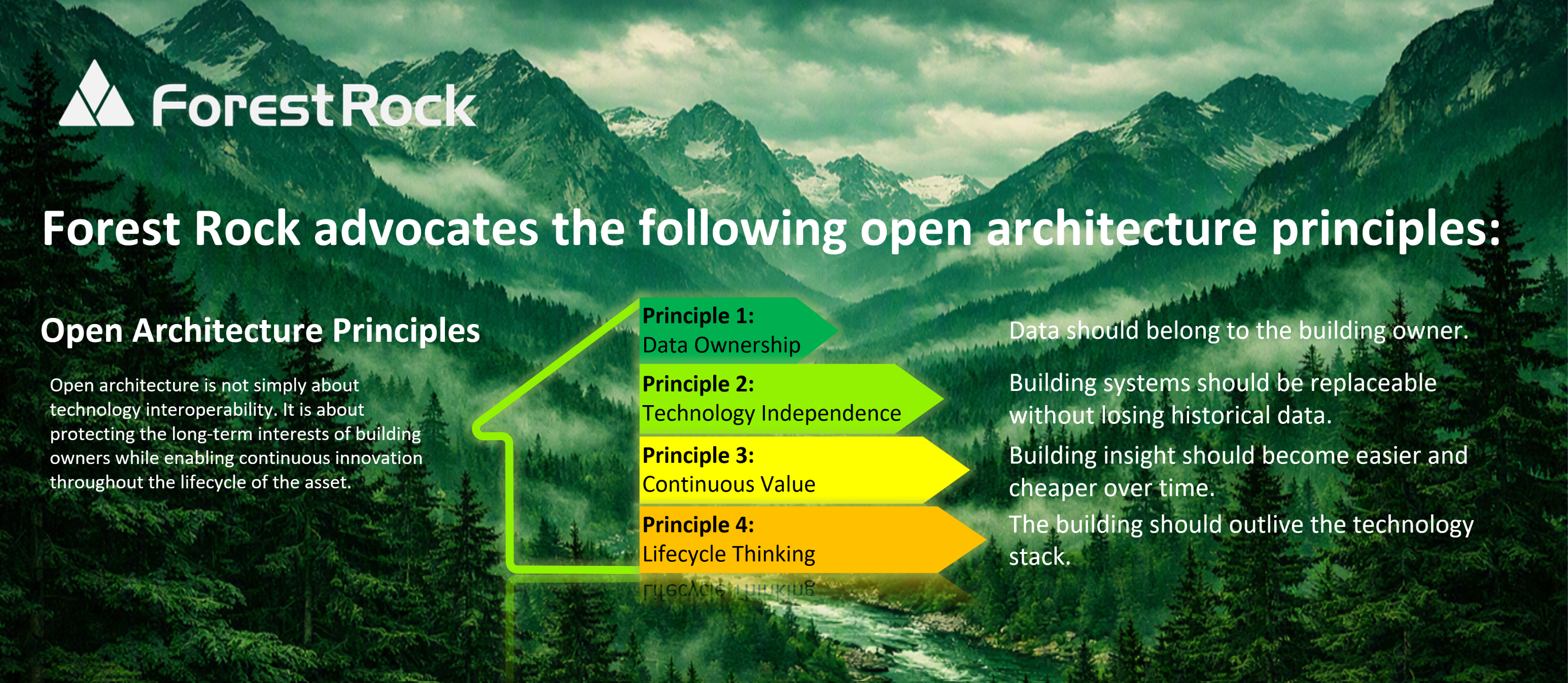
Data belongs to the building owner.
-
Collect data once and use it many times.
-
Open standards before proprietary interfaces.
-
Control locally and optimise globally.
-
Buildings must operate without the cloud.
-
Context is more valuable than volume.
-
Systems should be replaceable.
-
Data should survive technology refresh cycles.
-
Security is an architectural requirement.
-
Open architecture creates freedom of choice.
Beyond the Traditional BMS View
For many years, the Building Management System (BMS) was regarded as the centre of the smart building.
From a controls perspective, this remains true.
The BMS continues to provide critical functions such as:
-
HVAC control
-
Plant sequencing
-
Alarming
-
Scheduling
-
Operational visibility
However, modern buildings increasingly derive intelligence from systems that sit outside the traditional boundaries of the BMS.
Today, building performance is influenced by:
-
Energy management platforms
-
Occupancy analytics
-
Indoor environmental quality monitoring
-
LoRaWAN sensor networks
-
Workplace applications
-
Access control systems
-
Sustainability reporting tools
-
Artificial Intelligence platforms
The BMS remains essential.
It is just no longer the only source of intelligence.
As I noted in my article:
"For many years the Building Management System has been regarded as the heart of the smart building. While this remains true from a controls perspective, modern smart buildings increasingly rely on data, analytics and business intelligence that extend beyond the traditional boundaries of the BMS."
Paul Martin
Readers looking to explore this concept further can read:
➡️ The Smart Building Is Bigger Than the BMS | Knowledge Base
This companion article explains how modern smart buildings have evolved from control-centric systems into data-driven operational platforms.
Design Principle 1
Design the data architecture first and the equipment architecture second.
The most successful smart building projects are not defined by the controls system they use.
They are defined by how effectively information can be collected, shared, understood and reused throughout the lifecycle of the building.
Design Principle 2
Control locally. Optimise globally.
Buildings should continue to operate safely and effectively regardless of cloud connectivity or external platform availability. Critical control functions should remain close to the equipment they serve, while cloud platforms provide enterprise-wide visibility, analytics, benchmarking and optimisation.
Figure 1: From Data Silos to Open Building Intelligence
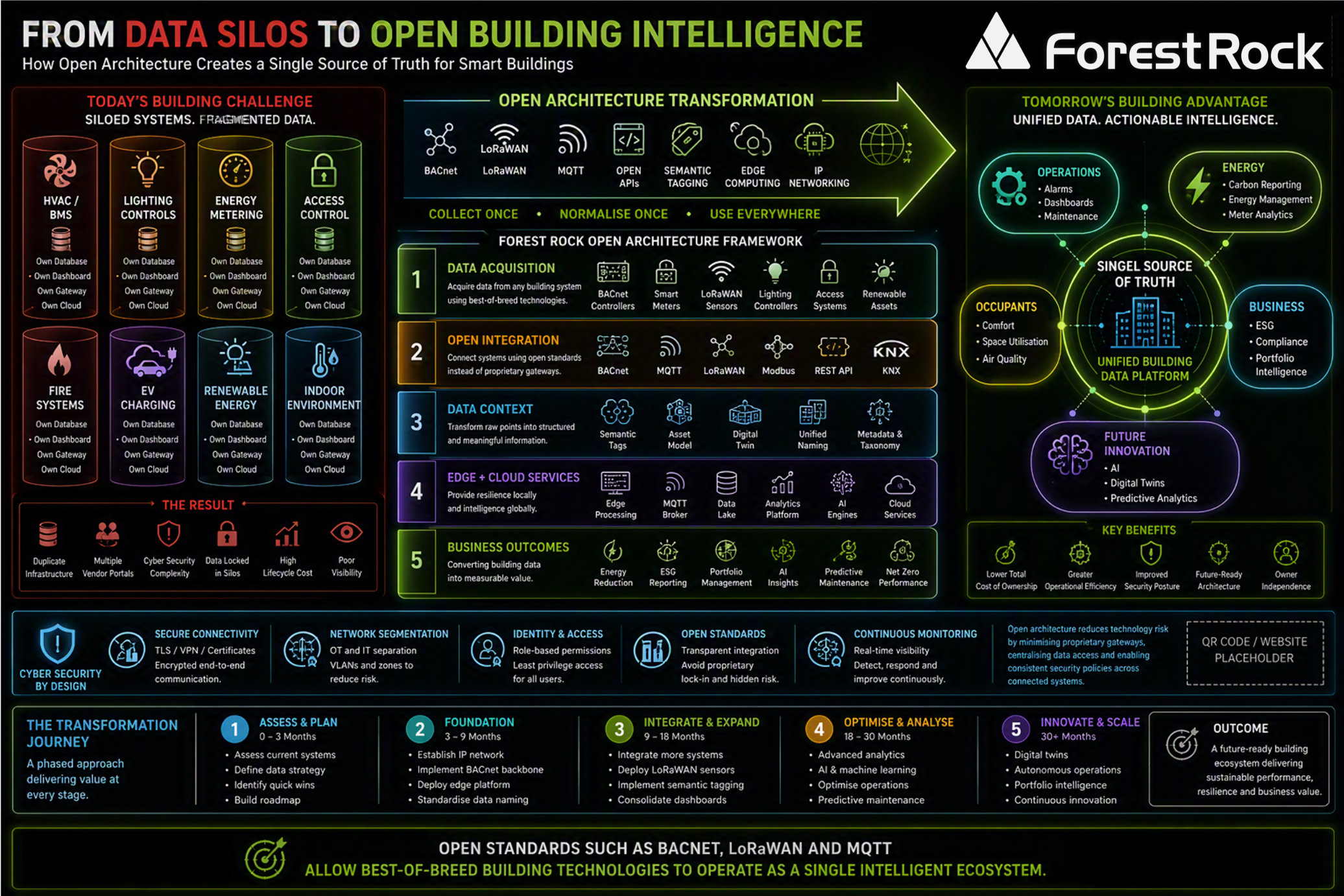
The Forest Rock Open Architecture Framework demonstrates how traditionally siloed building systems can be transformed into a unified data ecosystem using open standards including BACnet, LoRaWAN, MQTT, semantic tagging and secure edge-to-cloud integration.
The Data Silo Problem
Today's Building Reality
Most existing buildings resemble a collection of disconnected islands.
A Building Management System may control HVAC plant and room conditions.
A separate lighting control system manages occupancy and energy saving strategies.
An access control system tracks movement throughout the building.
Smart meters collect utility information.
Environmental sensors measure air quality.
EV chargers generate usage and billing data.
Renewable energy systems report generation and carbon savings.
Each system frequently has:
-
Its own database
-
Its own dashboard
-
Its own cloud connection
-
Its own support contract
-
Its own security model
-
Its own integration methodology
As additional technology is introduced, further silos are created.
Over time, organisations accumulate increasing amounts of information but decreasing visibility of overall building performance.
This creates several challenges.
Duplicate Infrastructure
Multiple gateways, servers, databases and communication platforms increase project cost and operational complexity.
Vendor Lock-In
Owners become dependent on individual suppliers to extract operational data or modify functionality.
Fragmented Security
Every additional connection introduces another potential attack surface that must be maintained and secured.
Reduced Operational Insight
Data remains isolated within individual applications, preventing organisations from understanding relationships between occupancy, comfort, energy consumption and equipment performance.
Increased Lifecycle Costs
Although proprietary solutions may appear attractive during procurement, long-term ownership costs increase significantly when integration becomes difficult or replacement options become limited.
The challenge facing modern buildings is no longer collecting data.
The challenge is bringing that data together.
The Transformation Journey
Forest Rock advocates a structured transformation from isolated building systems toward a unified, open architecture.
This transformation is not achieved through a single project or technology replacement.
Instead, it occurs through a phased journey.
Phase 1: Assess and Plan
0-3 Months
The first step is understanding the current estate.
Organisations should identify:
-
Existing systems
-
Available protocols
-
Current databases
-
Data ownership
-
Cyber security risks
-
Operational objectives
At this stage, the goal is not technology replacement.
The goal is establishing a data strategy.
Questions should include:
-
What information exists today?
-
Who owns it?
-
Who needs access to it?
-
What business outcomes are being pursued?
A clear roadmap should be established before introducing additional technology.
Phase 2: Build the Foundation
3-9 Months
Once the strategy is defined, the building requires a common framework for integration.
Forest Rock recommends:
-
Establishing an IP-based architecture
-
Implementing BACnet as the operational backbone
-
Deploying edge integration platforms
-
Standardising naming conventions
-
Introducing common security policies
At this stage, individual systems remain operational but begin participating within a common ecosystem.
The foundation is established for future expansion.
Phase 3: Integrate and Expand
9-18 Months
Once a common framework exists, previously isolated systems can begin sharing information.
New technologies can then be introduced using open standards.
Examples include:
-
LoRaWAN environmental monitoring
-
Smart metering
-
Occupancy analytics
-
Access control integration
-
Energy monitoring
Data becomes increasingly visible across organisational boundaries.
Operational teams no longer need to navigate multiple software platforms to understand building behaviour.
The building begins to function as a connected environment rather than a collection of systems.
Phase 4: Optimise and Analyse
18-30 Months
With data consolidated, greater value can be extracted.
This stage introduces:
-
Semantic tagging
-
Asset modelling
-
Energy analytics
-
Fault detection
-
Performance monitoring
-
Automated reporting
The focus shifts from collecting information to understanding information.
Data is transformed into operational intelligence.
Maintenance teams gain earlier visibility of failures.
Energy managers gain deeper insight into consumption patterns.
Facilities teams gain a clearer understanding of occupant experience.
Phase 5: Innovate and Scale
30+ Months
Once open architecture principles are embedded, organisations can continuously adopt emerging technologies without rebuilding the underlying infrastructure.
Future innovation may include:
-
Artificial intelligence
-
Digital twins
-
Predictive maintenance
-
Portfolio-wide benchmarking
-
Autonomous optimisation
-
Advanced ESG reporting
At this point, the building has evolved beyond automation.
It has become an intelligent operational platform.
The Forest Rock Open Architecture Framework
To achieve this transformation, Forest Rock recommends a layered architecture built around openness and interoperability.
Layer 1: Data Acquisition
Every intelligent building begins with data.
Information may originate from:
-
BACnet controllers
-
Building management systems
-
Smart utility meters
-
LoRaWAN sensors
-
Lighting controls
-
Access control systems
-
Renewable energy assets
-
Environmental monitoring devices
This layer represents the physical and operational reality of the building.
Layer 2: Open Integration
The integration layer removes barriers between technologies.
Forest Rock advocates using open standards including:
-
BACnet
-
LoRaWAN
-
MQTT
-
Modbus
-
REST APIs
-
KNX
The objective is not to eliminate technology diversity.
The objective is to ensure every technology can participate within a common ecosystem.
Layer 3: Data Context
Without context, building data provides limited value.
A point named:
TEMP001
reveals very little.
A point described as:
Building A > Level 3 > AHU-2 > Supply Air Temperature
provides meaning.
Open semantic tagging frameworks enable software applications to understand both the source and purpose of operational data.
This layer creates the foundation for analytics, digital twins and AI applications.
Layer 4: Edge and Cloud Services
Building operations require resilience.
Business intelligence requires scalability.
Neither should compromise the other.
Forest Rock recommends:
Edge Services
Responsible for:
-
Local control
-
Alarm processing
-
Autonomous operation
-
Critical infrastructure management
Cloud Services
Responsible for:
-
Portfolio analysis
-
Reporting
-
Benchmarking
-
Machine learning
-
Long-term data storage
This model ensures buildings remain operational even when cloud services are unavailable.
Control remains local.
Optimisation becomes global.
Layer 5: Business Outcomes
Technology should not be the final objective.
Business value should.
The upper layer of the architecture transforms operational information into measurable outcomes.
These include:
Energy Management
Reducing consumption and identifying inefficiencies.
ESG Reporting
Supporting sustainability and compliance objectives.
Portfolio Intelligence
Understanding performance across multiple buildings.
Predictive Maintenance
Reducing downtime and maintenance cost.
Occupant Experience
Improving comfort, air quality and building utilisation.
Net Zero Strategy
Providing the information required for long-term decarbonisation programmes.
Cyber Security by Design
Open architecture should never be confused with open access.
The more connected a building becomes, the more important cyber security becomes.
Forest Rock advocates security as an architectural principle rather than a product feature.
Every project should consider:
Secure Connectivity
Encrypted communications between devices, platforms and services.
Network Segmentation
Separation between operational technology and enterprise networks.
Identity and Access Management
Role-based permissions and authentication controls.
Continuous Monitoring
Visibility of devices, communications and operational anomalies.
Standardised Security Policies
Consistent controls across all connected technologies.
Well-designed open systems often present lower long-term risk than fragmented proprietary environments because security can be applied consistently across the entire ecosystem.
The Future State
The destination of the transformation journey is not a new Building Management System.
It is a unified building intelligence platform.
Data collected from HVAC systems, meters, sensors, lighting, access control, EV charging and renewable energy assets is contextualised and shared securely across the organisation.
Rather than supporting multiple disconnected workflows, the building becomes a common source of operational truth.
The benefits include:
-
Lower lifecycle costs
-
Reduced integration effort
-
Improved cyber security posture
-
Greater operational efficiency
-
Enhanced ESG performance
-
Improved occupant experience
-
Faster adoption of future technologies
-
Greater owner independence
Most importantly, organisations gain the ability to make decisions based on complete information rather than isolated datasets.
Open Architecture in Practice
Healthcare
Healthcare facilities require reliable environmental control, energy visibility and compliance reporting. By combining BACnet HVAC systems with LoRaWAN environmental monitoring and energy metering, organisations can gain greater visibility of critical spaces while improving comfort and reducing operational costs.
Outcomes
-
Better compliance
-
Better comfort
-
Better energy visibility
Commercial Offices
Commercial office buildings increasingly need to support hybrid working patterns while balancing operational costs and sustainability objectives. Combining occupancy analytics, access control data and HVAC optimisation enables facilities teams to understand how spaces are actually being used and adjust building services accordingly.
By integrating traditionally siloed systems into a common architecture, organisations can reduce energy consumption, improve occupant experience and make more informed workplace planning decisions.
Outcomes
-
Reduced energy consumption
-
Improved space utilisation
-
Better support for hybrid working
-
Enhanced workplace experience
Education
Educational facilities benefit from understanding both how learning spaces are utilised and how environmental conditions impact performance. Integrating indoor air quality monitoring, room utilisation analytics and energy monitoring creates a richer operational picture of the estate.
This approach enables universities, colleges and schools to improve learning environments while identifying opportunities to reduce costs and support sustainability initiatives across campuses.
Outcomes
-
Better learning environments
-
Improved indoor environmental quality
-
Enhanced utilisation visibility
-
Lower operating costs
Industry Statistics
Buildings account for approximately 30% of global final energy consumption and around 26% of energy-related emissions.
-
IEA
-
UK Government
-
CIBSE
-
RICS
Conclusion
Forest Rock believes that the next generation of smart buildings will be defined not by the sophistication of their controls systems, but by the quality, accessibility and longevity of their data.
Open architecture is ultimately about protecting the interests of the building owner.
It ensures that technology can evolve, suppliers can change and innovation can continue without sacrificing access to the information that drives operational performance.Buildings should not be designed around today's products.
They should be designed around tomorrow's possibilities.
By adopting open standards, prioritising interoperability and treating data as a strategic asset, organisations can create intelligent building ecosystems that continue to deliver value throughout the lifecycle of the asset.
Collect data once. Contextualise it properly. Share it securely. Use it everywhere.
“Open architecture is not a technology choice. It is a long-term strategy.”
Paul Martin - Forest Rock Technical Lead.
“Whether you are planning a new development, modernising an existing estate or defining a long-term digital building strategy, Forest Rock can help design an open architecture that protects investment, maximises interoperability and unlocks the value of building data.”

Learn | Integrate | Innovate
Welcome to the Forest Rock Learning Academy.
Real Knowledge. Real Engineers. Real Solutions.
follow-up paper:
"The Open Building Data Model: From BACnet to AI"