

Using Smart Controls and Energy Analytics To Improve Performance
Learning Objectives
After reading this article, you will be able to:
-
Understand why upgrading and optimising existing BEMS infrastructure is critical to achieving energy, carbon and operational performance goals.
-
Recognise the common challenges facing existing buildings and legacy control systems.
-
Understand the growing importance of operational data, analytics and reporting within modern buildings.
-
Identify how N4 Energy Manager complements existing BEMS infrastructure and enhances building performance visibility.
-
Evaluate how benchmarking, anomaly detection and energy analytics can support continuous improvement initiatives.
-
Appreciate why consultants and design engineers should consider specifying energy analytics platforms as part of retrofit projects.
Category: Building Management Systems (BMS)
Sub-Category: Building Performance & Energy Analytics
Estimated Reading Time: 8-10 Minutes
CPD Value: 0.10 Hours (Approximately)
What Is the Building Performance Gap?
Buildings rarely perform as efficiently as their designers intended and actual energy consumption can be significantly higher than predicted. Poorly implemented controls are recognised as a major contributor to this gap
Understanding BACS Performance Classes
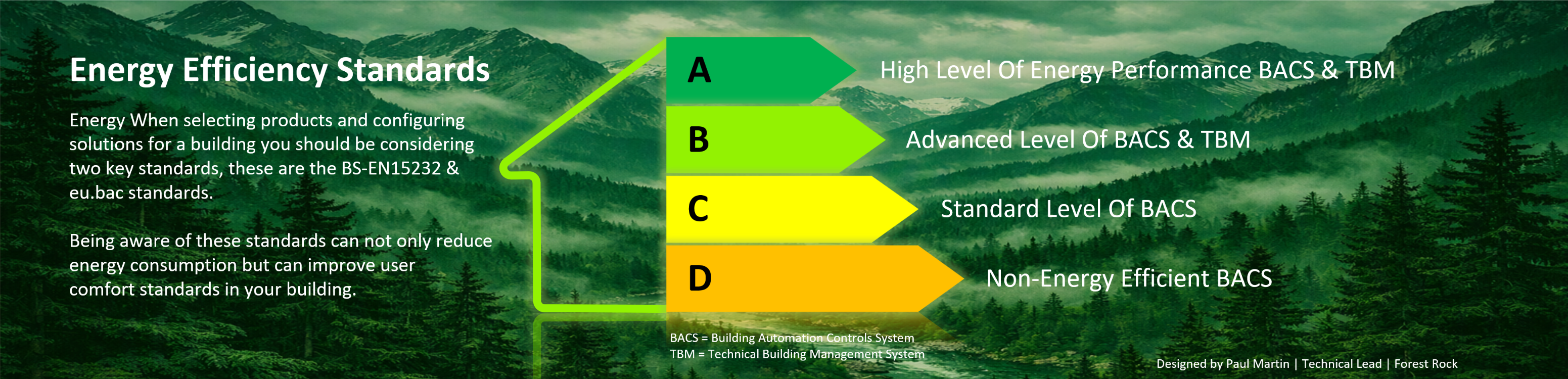
BS EN 15232 categorises Building Automation and Control Systems (BACS) into four performance classes, ranging from Class D (poor energy performance) to Class A (high-performance intelligent buildings). The higher the classification, the greater the expected energy efficiency and operational performance.
Class A - High Energy Performance BACS & TBM
Class A represents best practice building automation. Systems continuously respond to occupancy, demand and environmental conditions, ensuring energy is only used when required. Energy monitoring and sustainable energy optimisation are fundamental components.
Examples:
-
Meeting room fan coil units only enter comfort mode when the room is occupied.
-
Ventilation rates automatically increase or decrease based on CO₂ levels.
-
Lighting automatically adjusts according to occupancy and available daylight.
-
Heating and cooling systems are fully interlocked to prevent simultaneous operation.
-
Comprehensive energy monitoring and benchmarking are used to continually optimise performance.
Typical Outcome:
-
Lowest operating costs
-
Highest energy efficiency
-
Excellent occupant comfort
-
Continuous performance optimisation
Class B - Advanced BACS & TBM
Class B buildings incorporate many advanced control functions and provide good energy performance. However, they may lack some of the sophisticated demand-driven optimisation and automation features found in Class A systems. Energy monitoring remains a key characteristic.
Examples:
-
Networked room controllers are installed throughout the building.
-
Time schedules are combined with local room control.
-
Occupancy control may exist in selected areas.
-
Energy consumption is monitored and reported.
-
HVAC systems respond to changing conditions but may not be fully optimised on a room-by-room demand basis.
Typical Outcome:
-
Good occupant comfort
-
Strong energy performance
-
Suitable target for most modern commercial buildings
The BCIA recommends aiming for at least Class B performance rather than the baseline Class C.
Class C - Standard BACS
Class C is considered the reference level and represents a conventional BMS installation.
These systems provide central plant control and basic automation but often lack detailed room-level optimisation and advanced energy management capabilities. Energy monitoring is generally absent.
Examples:
-
HVAC plant operates on fixed schedules.
-
Heating and cooling are centrally controlled.
-
Basic room thermostats are used.
-
Limited or no occupancy-based operation.
-
No dedicated energy analytics platform.
-
Minimal visibility of actual efficiency performance.
Typical Outcome:
-
Acceptable comfort
-
Moderate energy efficiency
-
Limited insight into performance
Many existing commercial buildings operate at this level.
Class D - Non-Energy-Efficient BACS
Class D represents buildings with little or no effective automation. According to BS EN 15232, buildings operating at this level should be retrofitted and new buildings should not be designed to this standard.
Examples:
-
Manual control of heating and lighting.
-
No central building automation.
-
No occupancy control.
-
No energy monitoring.
-
Plant left running regardless of demand.
-
Heating and cooling conflicts are common.
Typical Outcome:
-
Highest operating costs
-
Significant energy waste
-
Poor visibility of performance
-
Increased carbon emissions
Find Your Building’s Energy performance certificate (EPC)
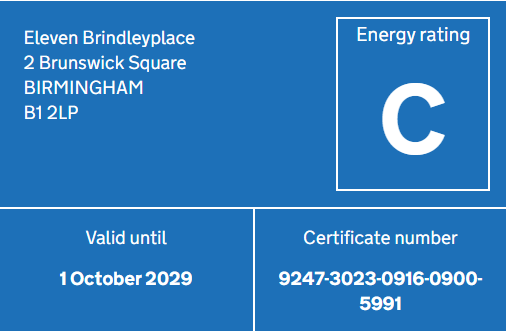
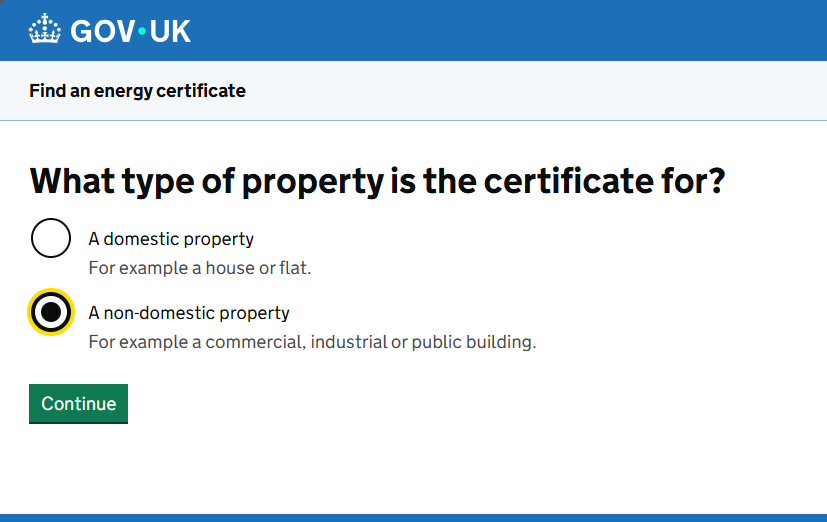
What type of property is the certificate for? – Find an energy certificate – GOV.UK
Commercial Energy Performance Certificates (EPCs) are a legal requirement for most non-domestic properties in the UK.
Whether you’re a landlord, investor, property manager, or occupier, securing a valid EPC is essential for staying compliant, protecting property value, and avoiding costly penalties.
EPC requirements vary based on your building type, usage, and current energy performance. These factors determine your EPC rating and whether your property can legally be let or sold.
How can I check my commercial building energy efficiency classification?
A very practical question, and one that many building owners and management companies struggle to answer.
Strictly speaking, there is no single "certificate" that declares your building as BS EN 15232 Class A, B, C or D. Instead, the classification is based on assessing the control functions installed and how they operate under EPC. But if your building hasn't been inspected then here is a quick self assessment checklist below:
Quick Self-Assessment
Likely Class D (Non-Energy Efficient)
Your building may be Class D if:
-
Heating and cooling are largely manual.
-
Little or no BMS exists.
-
No occupancy control.
-
No energy monitoring.
-
Plant runs on fixed schedules regardless of demand.
-
No room-level automation.
Likely Class C (Standard BACS)
Your building may be Class C if:
-
A BMS controls central plant.
-
HVAC runs to schedules.
-
Room thermostats provide local control.
-
Some time scheduling exists.
-
Little or no energy monitoring.
-
Limited occupancy-based control.
This is where many commercial buildings sit today.
Likely Class B (Advanced BACS)
Your building may be Class B if:
-
Networked room controllers are installed.
-
Occupancy influences HVAC operation.
-
Energy meters are monitored.
-
Demand-led ventilation is implemented in some areas.
-
Heating and cooling are coordinated.
-
Building performance is actively reviewed.
Likely Class A (High Performance BACS)
Your building may be Class A if:
-
HVAC responds dynamically to occupancy.
-
CO₂, temperature and other sensors adjust operation automatically.
-
Lighting responds to occupancy and daylight.
-
Heating and cooling are fully interlocked.
-
Comprehensive energy monitoring is in place.
-
Continuous optimisation and performance management occur.
BCIA - The Impact of Controls on the Energy Efficiency of Buildings.
Where Does N4 Energy Manager Fit?
A useful way to explain this in the article is:
BS EN 15232 defines how efficiently a building should operate. N4 Energy Manager helps building owners measure, benchmark and verify that performance.
While a building may have the control strategies needed to achieve a Class A or Class B rating, N4 Energy Manager provides the analytics layer required to prove that those strategies are delivering the expected results through benchmarking, energy ranking, regression analysis, anomaly detection and automated reporting.
Class D → Class C → Class B → Class A → Continuous Optimisation with N4 Energy Manager.
If you need more help:
Then why not contact our sales or support team.

sales@forestrock.co.uk or support@forestrock.co.uk
Learn | Integrate | Innovate
Welcome to the Forest Rock Learning Academy.
Real Knowledge. Real Engineers. Real Solutions.