

Learning Objectives
By the end of this module, you will be able to:
✅ Understand what control theory means within a Building Management System (BMS)
✅ Explain the difference between Open Loop and Closed Loop control
✅ Understand how sensors, controllers and actuators work together
✅ Recognise common BMS control strategies
✅ Understand the purpose of Setpoints, Deadbands and Hysteresis
✅ Explain the basics of PID (Proportional, Integral and Derivative) control
✅ Understand why effective control strategies improve comfort, efficiency and equipment life
Category: Building Management Systems (BMS) Fundamentals
Knowledge Level: Beginner to Intermediate
Estimated Reading Time: 12-15 Minutes
Why Control Theory Matters
A Building Management System is much more than a way to monitor temperatures and switch equipment on and off. The primary role of a BMS is to continuously control building services to achieve specific objectives, such as:
-
Maintaining comfortable temperatures
-
Providing healthy indoor air quality
-
Controlling humidity levels
-
Maintaining pressure relationships
-
Reducing energy consumption
-
Protecting equipment
-
Optimising building performance
Without effective control strategies, even the most advanced HVAC equipment would operate inefficiently and struggle to maintain stable conditions.
Control theory provides the framework that allows a BMS to make intelligent decisions based on
real-world operating conditions.
The Basic Control Loop
Most HVAC control systems follow a simple process:
Measure
Sensors continuously monitor conditions within the building.
Examples include:
-
Temperature sensors
-
Humidity sensors
-
CO₂ sensors
-
Pressure sensors
-
Flow sensors
Compare
The controller compares the measured value against a desired target value known as the Setpoint.
Decide
The controller calculates what action is required.
Act
A control device responds to the controller's output.
Examples include:
-
Valves
-
Dampers
-
Variable Speed Drives (VSDs)
-
Actuators
-
Electric heaters
The process repeats continuously, often several times every second as demonstrated in this example below.
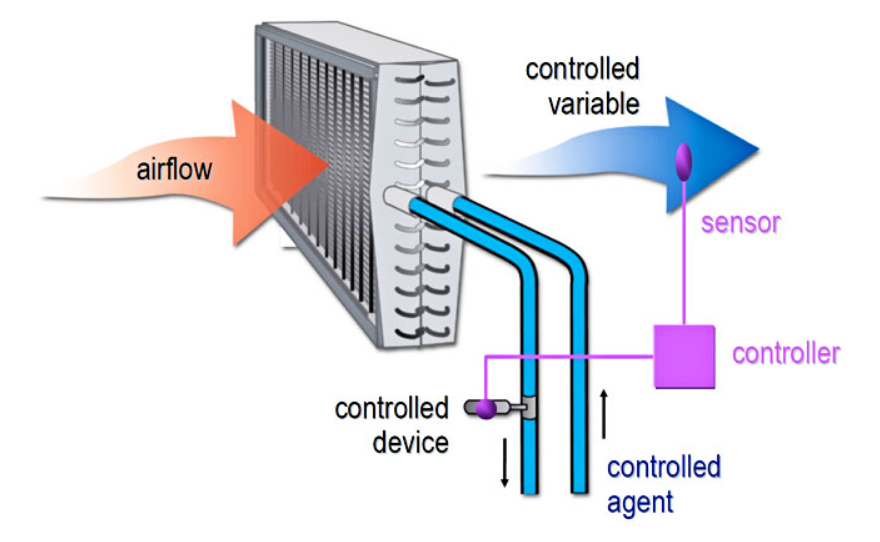
Understanding the HVAC Control Loop
The example above illustrates a basic HVAC control loop, the foundation of most Building Management System (BMS) strategies. In this system, warm air passes across a chilled water cooling coil. As air flows over the coil's fins and tubes, heat is transferred from the air into the chilled water circuit. By adjusting the flow of chilled water through the coil, the system can control the temperature of the air supplied to the space.
To achieve this automatically, several key components work together in a continuous feedback process.
Controlled Variable
The controlled variable is the condition the system is trying to maintain. In this example, the controlled variable is the leaving air temperature downstream of the cooling coil.
Sensor
The sensor continuously measures the controlled variable and provides real-time information to the controller. Here, a temperature sensor monitors the air temperature leaving the cooling coil.
Controller
The controller acts as the decision-making element of the system. It compares the measured temperature against the desired temperature, known as the setpoint, and determines whether corrective action is required.
Controlled Device
The controlled device receives commands from the controller and makes physical adjustments to the system. In this example, the controlled device is a modulating control valve.
Controlled Medium
The controlled medium is what the controlled device regulates to influence the controlled variable. Here, the medium is chilled water flowing through the cooling coil. Opening the valve increases water flow and cooling capacity, while closing the valve reduces cooling output.
Bringing It All Together
When these elements operate together, they form an automatic control system known as a control loop. The sensor measures the actual condition, the controller compares it to the setpoint, and the controlled device adjusts the system to maintain the required performance.
This continuous cycle of Measure → Compare → Decide → Act → Feedback is at the heart of building automation and allows HVAC systems to maintain comfort, improve energy efficiency, and respond automatically to changing conditions.
The two most common control loop strategies used within HVAC and BMS applications are:
-
Open-Loop Control – control actions are taken without feedback from the result.
-
Closed-Loop Control – feedback is continuously monitored and used to adjust system performance.
Understanding these control strategies is fundamental to designing, commissioning, and troubleshooting modern Building Management Systems.
Open-Loop Control
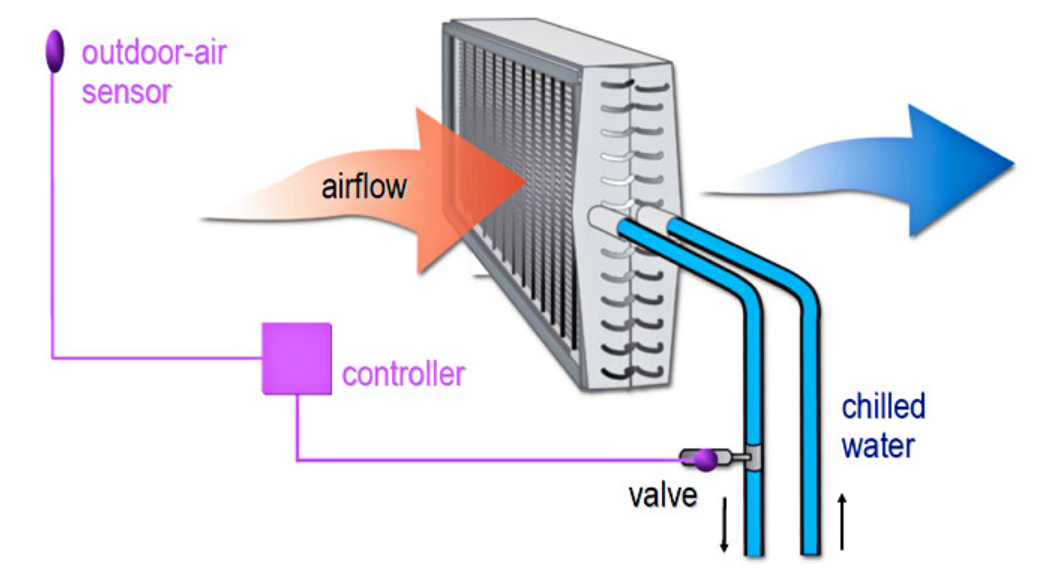
An open-loop control strategy operates using a predefined relationship between an external condition and the desired system response. Rather than measuring the actual result of the control action, the controller makes decisions based solely on an external input.
In the example shown below, an outdoor air temperature sensor provides information to the controller. The controller compares this value against a programmed control strategy and adjusts the cooling valve position to increase or decrease the cooling coil capacity.
The key assumption is that a predictable relationship exists between outdoor temperature and the cooling demand of the building. While this approach can be simple to implement, it does not verify whether the required air temperature is actually being achieved.
Limitations of Open-Loop Control
Because the system does not monitor the controlled variable directly, it cannot account for changes that may affect performance, such as:
-
Variations in supply airflow
-
Changes in chilled water temperature
-
Occupancy fluctuations
-
Internal heat gains from people, equipment, or solar load
-
Changes in plant performance
As a result, the system may deliver too much or too little cooling. This can lead to:
-
Reduced occupant comfort
-
Increased energy consumption
-
Poor temperature stability
-
Inefficient plant operation
Why Open-Loop Control Is Rare in HVAC Systems
Modern HVAC and Building Management Systems are designed to respond to actual operating conditions rather than assumed ones. Since open-loop control relies on a fixed relationship between an external factor and system demand, it cannot automatically correct for unexpected changes within the system.
For this reason, open-loop control is generally limited to specialised applications. Most HVAC systems instead use closed-loop control, where feedback from sensors is continuously monitored and used to adjust system performance, ensuring greater accuracy, comfort, and energy efficiency.
Key Learning Point: Open-loop control acts based on what it expects to happen. Closed-loop control acts based on what is actually happening. This distinction is fundamental to understanding modern BMS control strategies.
Closed-Loop Control
A closed-loop control strategy continuously monitors the actual condition being controlled and adjusts system operation in response to real-time feedback. Rather than relying on assumptions, the controller bases its decisions on measured performance.
In this example, a temperature sensor measures the air temperature leaving the cooling coil and sends this information to the controller. The controller compares the measured temperature with the required setpoint and automatically adjusts the control valve position to maintain the desired leaving-air temperature.
Because decisions are based on actual operating conditions, the system can respond to changes in airflow, chilled water temperature, occupancy levels, and other factors that influence performance.
Benefits of Closed-Loop Control
By continuously measuring, comparing, and correcting system operation, closed-loop control delivers:
-
More accurate temperature control
-
Improved occupant comfort
-
Reduced energy consumption
-
Greater system stability
-
More efficient plant operation
Why Closed-Loop Control Is Preferred
Most modern HVAC and Building Management Systems use closed-loop control because it provides reliable and consistent performance under changing conditions. By using real-time feedback to drive control decisions, the system can continually optimise operation and maintain the required environmental conditions.
Key Learning Point: Closed-loop control measures the actual result, compares it to the desired outcome, and automatically makes adjustments. This feedback-driven approach is the foundation of effective HVAC and BMS control strategies.0
Control Reset Strategy
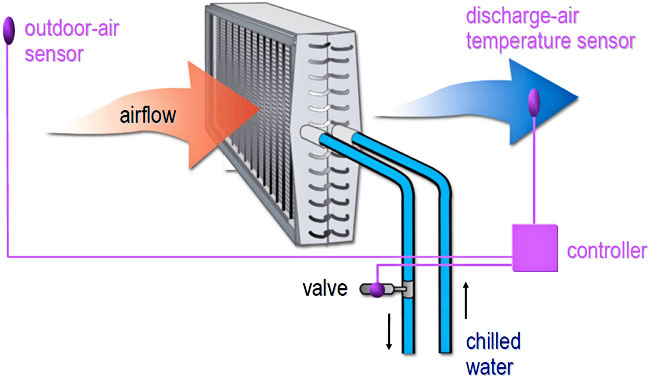
In some applications, a controller can combine the benefits of both closed-loop and open-loop control. This approach allows the system to maintain precise control of the controlled variable while also adapting to changing external conditions.
In the example shown below, a closed-loop control strategy continuously monitors the temperature of the air leaving the cooling coil and adjusts the control valve to maintain the required setpoint. At the same time, a second sensor measures the outdoor air temperature.
As outdoor conditions change, the controller automatically adjusts, or resets, the leaving-air temperature setpoint. For example, as the outdoor temperature falls, the controller may increase the leaving-air temperature setpoint, reducing the amount of cooling required while still maintaining acceptable indoor conditions.
How Control Reset Works
In this arrangement:
-
The closed-loop sensor provides the primary feedback used to maintain accurate temperature control.
-
The outdoor air sensor provides secondary information that influences the target setpoint.
-
The controller continuously adjusts system operation based on both internal performance and external conditions.
Benefits of Control Reset
By adjusting setpoints to match changing building demands, control reset can deliver:
-
Improved energy efficiency
-
Reduced plant operating costs
-
More stable system operation
-
Enhanced occupant comfort
-
Better overall system performance
Why Control Reset Is Widely Used
Control reset is a common strategy in modern HVAC and Building Management Systems because it enables equipment to operate only as hard as necessary. By combining the accuracy of closed-loop feedback with the adaptability of open-loop influence, the system can maintain comfort conditions while minimising unnecessary energy consumption.
Key Learning Point: Control reset uses real-time feedback to maintain control while adjusting setpoints based on changing external conditions. This allows HVAC systems to optimise performance, improve efficiency, and reduce energy use without compromising occupant comfort.
Understanding Setpoints
A Setpoint is the target value the controller is trying to achieve.
Examples:
|
Variable |
Typical Setpoint |
|---|---|
|
Office Temperature |
22°C |
|
Operating Theatre Temperature |
21°C |
|
Relative Humidity |
50% RH |
|
CO₂ Level |
800 ppm |
|
Supply Air Pressure |
250 Pa |
The controller's job is to minimise the difference between the actual value and the setpoint.
This difference is known as the Error.
What Is Deadband?
A Deadband is a range around the setpoint where no control action occurs.
Example
Room Temperature Setpoint = 22°C
Deadband = ±1°C
No action occurs while temperature remains between:
-
21°C
-
23°C
This prevents unnecessary adjustments and reduces wear on equipment.
What Is Hysteresis?
Hysteresis prevents equipment from rapidly switching on and off.
Example
Heating Setpoint = 22°C
Heating Turns On At:
-
21°C
Heating Turns Off At:
-
22°C
The gap between the ON and OFF points creates stability.
Without hysteresis, equipment could cycle continuously, leading to:
-
Energy waste
-
Increased maintenance
-
Reduced equipment life
Control Devices
A BMS typically controls various devices throughout the building.
Valves
Used to regulate:
-
Heating water flow
-
Chilled water flow
Dampers
Used to regulate:
-
Supply air
-
Return air
-
Fresh air
-
Exhaust air
Variable Speed Drives (VSDs)
Used to control:
-
Fans
-
Pumps
-
Compressors
By varying motor speed, significant energy savings can be achieved.
Electric Heaters
Used where direct electric heating is required.
Introduction To PID Control
Most modern HVAC control loops use PID control.
PID stands for:
Proportional (P)
Responds to the current error.
Large error = larger response.
Integral (I)
Looks at accumulated error over time.
Helps eliminate small offsets that remain after proportional control.
Derivative (D)
Predicts future behaviour based on the rate of change.
Helps prevent overshoot and improves stability.
Example PID Control
Setpoint = 22°C
Actual Temperature = 18°C
The controller detects a 4°C error.
The PID algorithm calculates:
-
How far away the temperature is
-
How long it has been away
-
How fast it is changing
The controller then adjusts the valve, fan or heating source accordingly.
PID control provides smooth and accurate regulation compared to simple on/off control.
Real-World HVAC Example
Consider a VAV-served office area.
The BMS:
-
Measures room temperature
-
Compares it against the setpoint
-
Calculates the error
-
Adjusts VAV damper position
-
Adjusts AHU supply fan speed
-
Continues monitoring conditions
This process happens continuously to maintain occupant comfort while using the minimum amount of energy.
Why Good Control Strategy Matters
A well-designed control strategy can deliver:
✅ Improved occupant comfort
✅ Better indoor air quality
✅ Reduced energy consumption
✅ Lower carbon emissions
✅ Reduced equipment wear
✅ Lower maintenance costs
✅ Extended asset life
In many modern buildings, the quality of the control strategy has as much impact on performance as the HVAC equipment itself.
Key Takeaways
-
Control theory is the foundation of all BMS operation.
-
Most HVAC systems use Closed Loop Control.
-
Sensors provide feedback to controllers.
-
Setpoints define desired operating conditions.
-
Deadbands and Hysteresis improve stability.
-
PID control provides accurate and efficient regulation.
-
Good control strategies improve comfort, efficiency and equipment reliability.
If you need more help:
Then why not contact our sales or support team.

sales@forestrock.co.uk or support@forestrock.co.uk
Learn | Integrate | Innovate
Welcome to the Forest Rock Learning Academy.
Real Knowledge. Real Engineers. Real Solutions.