

Learning Objectives
After reading this article you will be able to:
-
Explain the purpose and function of a Building Management System.
-
Describe the evolution of building controls from relay-based systems to modern distributed control systems.
-
Identify the major hardware and software components found in a BMS.
-
Explain how controllers, sensors, actuators, networks, and supervisor software interact.
-
Describe the benefits of BMS technology for different building stakeholders.
-
Recognise common industry terminology and acronyms associated with BMS.
-
Understand the importance of open communications protocols in modern building automation.
-
Identify common BMS faults and their underlying causes.
-
Explain how a BMS contributes to energy efficiency, occupant comfort, and plant reliability.
-
Apply this foundational knowledge as a basis for further study of BMS architecture, networking, programming, and integration.
Introduction
This chapter introduces building management systems and provides a brief history of its evolution.
By the end of this chapter, you should have had the chance to understand what are building management systems, what are the benefits of such a system as well as the drawbacks of these systems.
What is a Building Management System
A Building Management System (BMS) is an intelligent microprocessor-based controllers networked and installed to monitor and control the building's mechanical and electrical systems and services such as heating, ventilation, air conditioning (HVAC) as well as lighting and hydronics. BMS is now an integral part of modern buildings.
Types of BMS range from systems serving small offices, shopping centres, factories to the systems serving data centres, pharmaceutical plants, and financial services providers. For an office building, the environmental controls should meet the requirements of people working in the space. For shopping centres, again the environmental controls should be for the comfort of the people, but due to the transient nature of the building, the controls shall be configured slightly differently.
Each building type should have its environmental controls configured such that it meets the needs of the building and/or occupants.
Good BMS are essential for the safe and efficient operation of a building. The BMS does more than simply keep environmental conditions comfortable for building occupants. A BMS is required to keep the heating, ventilation and air conditioning equipment operating efficiently and also to ensure that the equipment operates safely in the event of a system fault or an unforeseen safety issue. The BMS must also be capable of communicating with the facility personnel on space conditions as well as the plant operation, this is achieved through the Supervisory PC. With an increasing emphasis on energy conservation and reduction in greenhouse gas emissions, BMS controls are now required to be more efficient.
Historically when a BMS was selected for use in a building, a system with a proprietary protocol was selected and all equipment was generally supplied from that one manufacturer.
The current generation of BMS is now based on open protocol communications allowing full system integration from multiple system vendors.
BMS is a control process in which the controller continuously reads environmental process variables (measured values by sensors) into its software which produces corrective actions in response to the changing conditions. These corrective actions drive outputs, or actuators, which affect the environmental conditions to bring them closer to the desired conditions.
Knowledge Check List Questions:
What is the primary purpose of a Building Management System?
A. To replace mechanical equipment
B. To monitor and control building services
C. To generate electrical power
D. To replace facility managers
Answer: B
Which building systems are typically controlled by a BMS?
(Select all that apply)
-
Heating
-
Ventilation
-
Air Conditioning
-
Lighting
-
Water Systems
Answer: All of the above
Complete the sentence:
A BMS continuously reads __________ from sensors and responds by driving __________.
Answer: process variables, actuators
True or False
A BMS is only used in large commercial office buildings.
Answer: False
Jargon Buster
You will hear Building Management Systems be called different names as well as being referenced under different acronyms.
For this section, I will keep to BMS for Building Management Systems. The following terms may also be applied to these systems:
-
Building energy management systems (BEMS)
-
Building automation systems (BAS)
-
Building management and control systems (BMCS)
-
Direct digital controls (DDC)
Other terminology you may hear concerning BMS operator workstations, which is the operators window into the system:
-
Supervisory or supervisor PC
-
Control and data acquisition (SCADA)
-
Programmable logic controller (PLC)
-
Energy management system (EMS)
-
Graphical user interface (GUI)
-
Front End
-
Head-End
History of Building Management Systems
Before Richard Morley of Bedford Associates invented the PLC back in 1968, vacuum tubes were used for calculation while relays were used for control. The primary difference between the vacuum tube and relay was the speed of switching and the current draw. Relays required more current and were slower to switch than vacuum tubes.
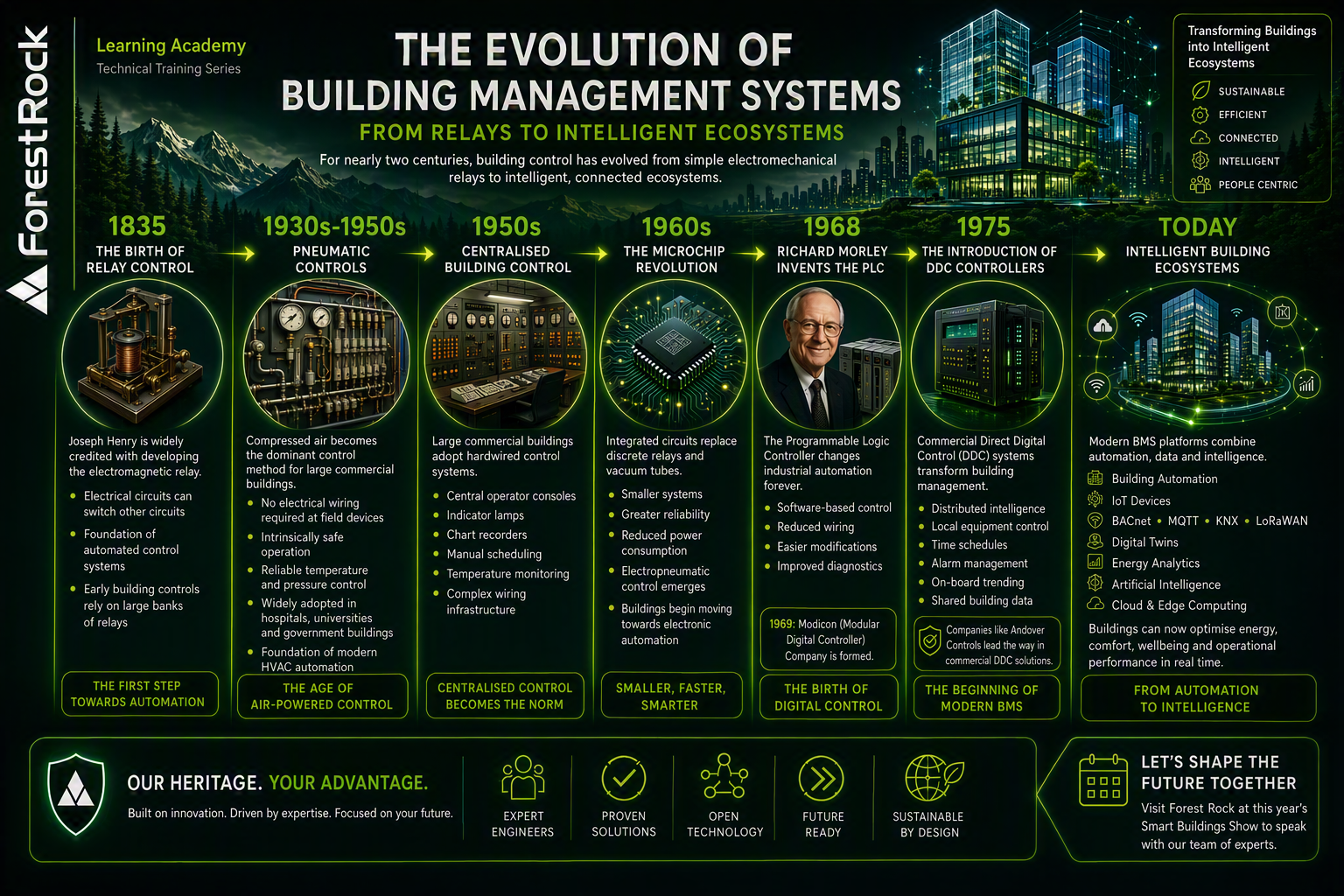
Invented in 1835, by an American named Joseph Henry, at the College of New Jersey, relays utilise an electromagnet to move an armature between a normally open and a normally closed contact when current is applied. Relays are used to switch smaller currents and are not used to control equipment consuming larger power.
Using relays only, to build up complex logic for a standard HVAC control, often required a large volume of relays which had to be housed in several control cabinets. These cabinets would require a lot of space and were not flexible if you needed to retrospectively change the control sequence. Troubleshooting was also extremely difficult, as issues could arise from dirty contacts, loose wires and faulty components.
In 1968, Richard Morley of Bedford Associates along with several other engineers came up with the idea of the PLC The following year, the Modicon (Modular Digital Controller) Company was formed with the view to develop and build a business around this new line of controllers.
The earliest form of building control was a hardwired central control system deployed in large buildings in the late 1950s. Field devices were wired back to a central console with dials, indicator lights and chart recorders which allowed the operator to monitor plant and view measured values. It took human intervention to change settings and operation times. Temperature sensors consisted of a variable resistor providing 100052 (Ohm) at 21°C. These sensors provided input to a vacuum-tube amplifier that drove an actuator to control either a damper of a valve.
The early 1960s brought about advancements in integrated circuits. Vacuum tubes and relay operation were now condensed onto one single integrated circuit. These systems were then replaced with local control panels connected across the telephone system. Electropneumatic transducers allowed these chips to drive the actuators. With the rapid advances in microchip technology, BMS came into existence in the 1970s.
It was at this time Richard Morley realized that his newly invented PLC would start to become obsolete in building automation applications as the PLC was prohibitively expensive for use in building automation. The speed at which PLCs execute is in the millisecond range and this speed was not required for thermal comfort. PLCs were designed for a single user interface through a local interface known as a human-machine interface (HMI). Alarm detection and data logging can be achieved through the Supervisory Control and Data Acquisition (SCADA) system and not locally on the controller. which meant with the loss of communication network, information was lost. In 1975 Richard Morley incorporated Andover Controls bringing the first DDC controller to market. (Side Note: Where did our MD develop his skills for software development)
DDC is a distributed control system with intelligence sitting on each piece of equipment and common information shared across the system, such as outside air temperature (OAT). DDC utilised timeclocks, unlike PLCs and data logging was carried out on the controller itself in onboard memory (RAM).
Both Andover Controls and Modicon companies were eventually acquired by Schneider Electric. By distributed control, this means that the controller is located local to the equipment. If the controller loses network connectivity, the control functions will still operate if programmed correctly.
Components of a Building Management System
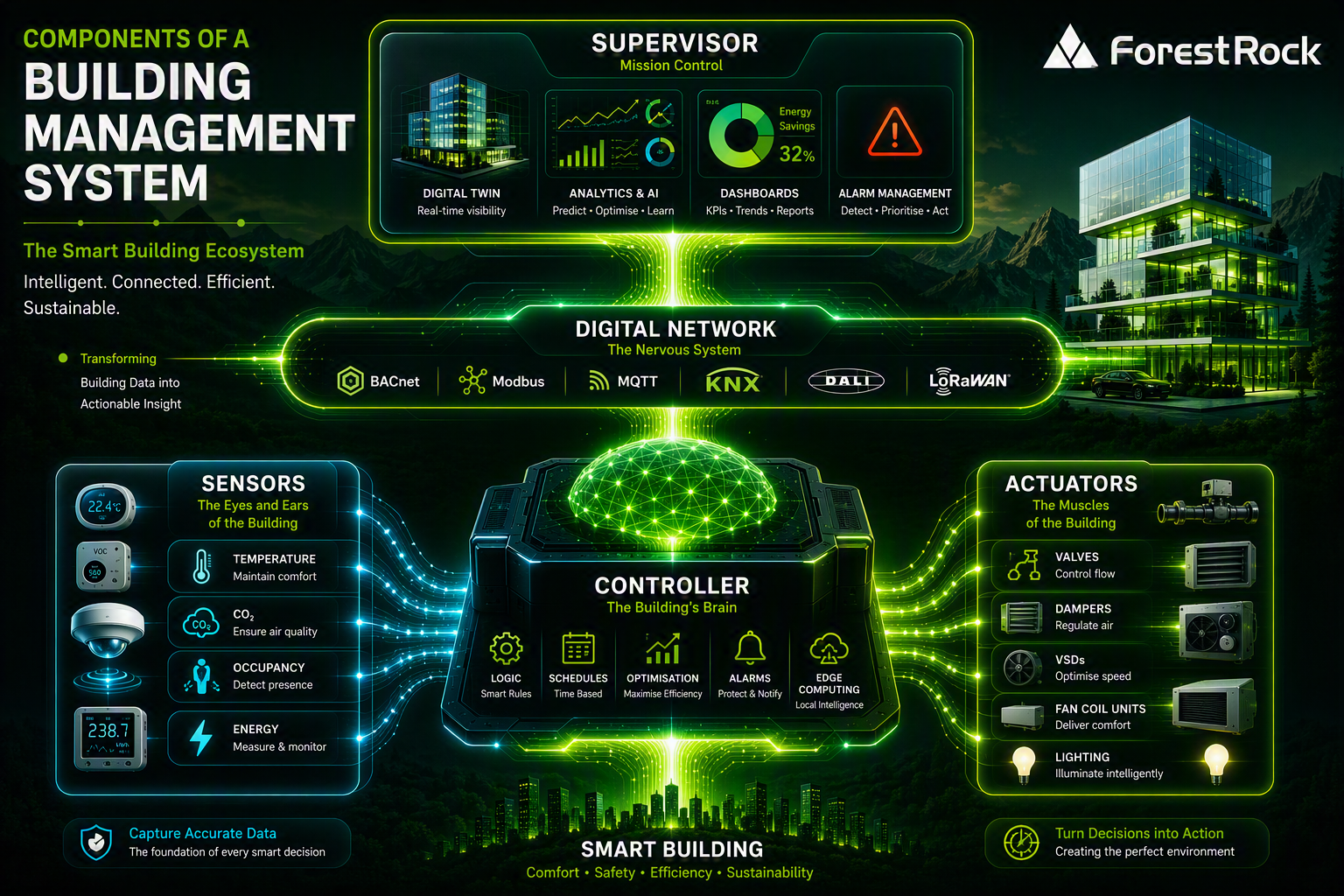
As was briefly touched on earlier the BMS is broken down into a few different levels.
-
Field devices - these are all of the sensors and actuators, mounted remotely from the controller and close to the equipment that is being monitored or controlled.
-
Controller - the controller can be loaded with a custom program or can be loaded with a
pre-programmed unitary controller. The controller takes in the sensor values and calculates the required outputs to drive actuators. The controller typically has onboard memory to store alarms and trend logs in the case of a network failure. -
Network - all input, outputs, internal calculations, time schedule, trend logs and alarms can be transmitted across a network to a Supervisory PC to display the information. The network can be used for two way information transfer, so information, such as setpoint changes, can be transmitted from the Supervisory PC back to the controller.
-
Supervisor PC displays the information in the field and from within the controller. This information can be space temperature, electrical voltages, valve or damper positions, and so forth. Information from the controller can also be displayed, such as loop out as well as control loop parameters, such as the gain. Any points exposed as setpoints can be adjusted from the supervisor. Trend logs are collected by the supervisor also, typically once a day depending on interval and is done at a time when the network is quite - middle of the night. Alarms are displayed on the supervisor and can be re-transmitted to email for high priority alarms.
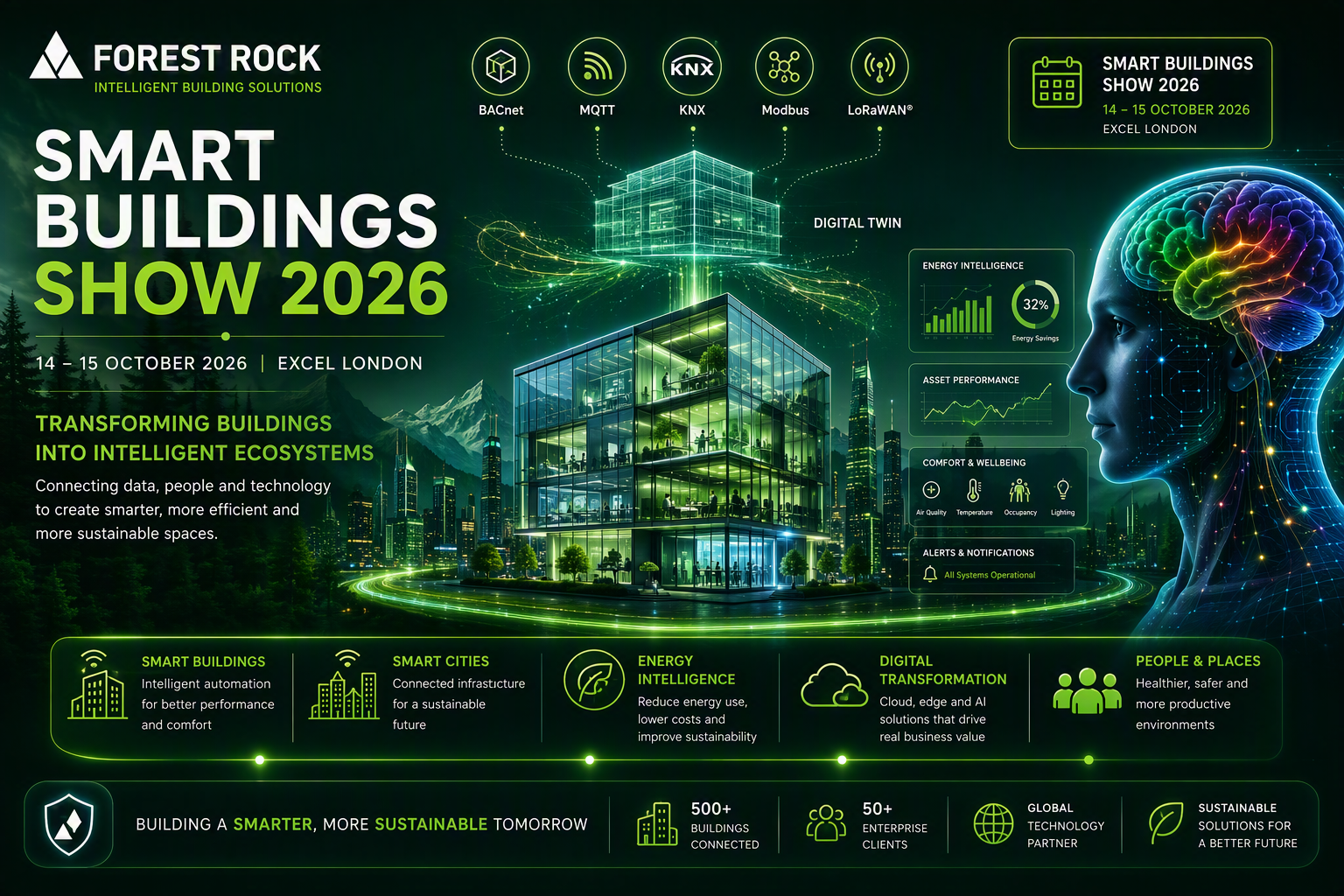
If you'd like to learn more about the components of a Building Management System (BMS) and how they work together to create smarter, more efficient buildings, come and meet us at this year's
Smart Buildings Show.
Our team of experienced engineers and smart building specialists will be on hand to discuss your building automation challenges, energy management goals, digital transformation projects, and integration requirements. Whether you're planning a new installation, upgrading an existing system, or simply exploring what's possible, we'd be delighted to talk through your requirements and share our expertise.
Based in the UK and Ireland, we specialise in IoT, Smart Buildings, Smart Cities, & Smart Grid solutions. We enable businesses, property owners, and occupants to better understand and control their facilities, to make informed decisions that are good for their pocket and the planet, and to increase their wellbeing and comfort.
We guide businesses through their digital transformation, leading the deployment of connected devices in industrial and commercial applications. Our team spans experienced engineers, young innovators and enterprise experts to deliver pioneering building automation solutions bringing value directly to your company.
Based on Loughborough University’s Science and Enterprise Park, we are plugged in to one of Europe’s most dynamic innovation communities. Fostering collaboration with world class researchers, we thrive on the cutting edge of IoT technologies; from energy management, through smart buildings, to global systems. Surrounded by global brands and closely collaborating with the University itself, Forest Rock stays at the forefront of IoT development.
Why Use a Building Management System
The benefits that a BMS can bring are varied depending on what you need from the system. The below benefits will only be realised once the system is correctly installed, configured, commissioned and maintained. The lists below are in no particular order.
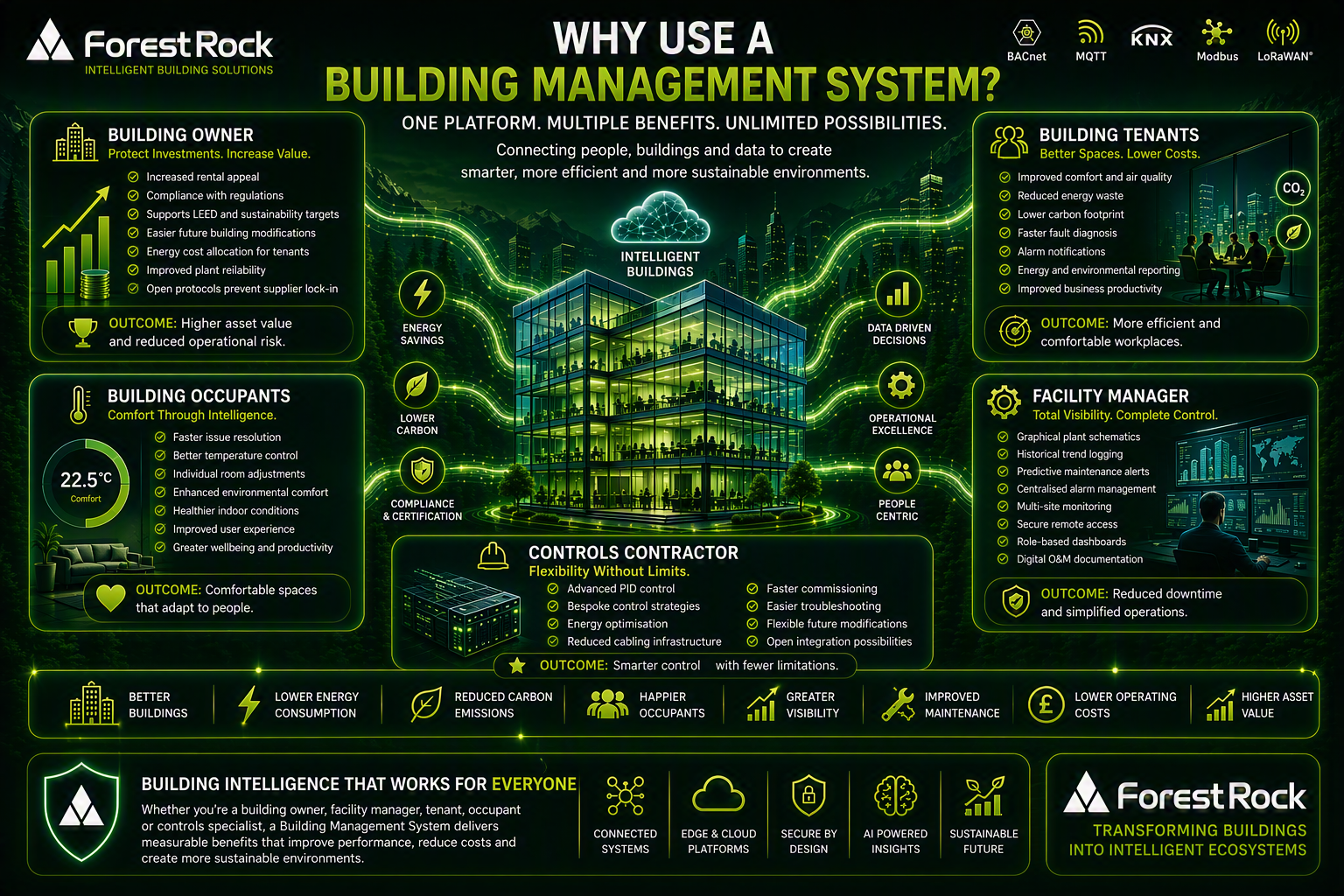
Building Owner
Owners of buildings with a Building Management System (BMS) enjoy several advantages:
A BMS can boost a building’s rental appeal. The energy savings provided by a BMS make such properties more attractive compared to those without a BMS. Additionally, the various benefits outlined here contribute to enhancing the building’s rental value.
In certain areas and under specific conditions, installing a BMS is mandatory. Essentially, a BMS aids in adhering to local laws. For instance, Ireland’s 2017 Building Regulations for non-residential structures stipulate the basic requirements for BMS to manage heating, cooling, and ventilation systems efficiently. The United Kingdom has a similar document. For certifications like LEED, it’s necessary to maintain environmental and energy records for three years, which can be stored within the BMS database.
A BMS simplifies the process of making functional modifications to a building. For example, the addition of a cellular office to a structure lacking a BMS could complicate temperature control. However, with a BMS, it’s a matter of installing a new temperature sensor and implementing the suitable control strategy.
BMS can distribute energy costs in a multi-tenant building using MID compliant meters.
Customized BMS controllers enhance plant dependability by enabling effective failover strategies during system failures. Promptly shutting down equipment upon fault detection can prolong its lifespan.
Opting for a BMS with an open protocol affords building owners the flexibility to choose from various suppliers, avoiding commitment to a single installer or product line.
Building Tenants
Tenants in buildings equipped with a Building Management System (BMS) enjoy several benefits:
A BMS optimizes environmental conditions, which can enhance productivity. It regulates not just temperature and humidity but also air quality through carbon dioxide sensors.
Statistical data indicates that workspaces are often vacant for considerable periods. For instance, if an office is used for 12 hours daily from Monday to Friday, it remains empty for roughly 60% of the week. Such vacancy can lead to energy wastage and increased carbon emissions. In the UK, the Building Research Establishment (BRE) has found that this can account for 25% to 50% of a building’s energy consumption. A BEMS can cut this waste to under 15%, thereby reducing annual carbon emissions.
The BMS provides tools for diagnosing equipment issues. Trend logs allow users to review system activity over time. This is particularly crucial in pharmaceutical or food plants where batch issues may arise, as trend logs can shed light on environmental conditions at critical times. The BMS also logs alarms related to equipment and environmental conditions, aiding in pinpointing failures. With synchronized controllers, the origin of faults can be traced. For instance, in electrical monitoring, it’s beneficial to determine whether a mechanical plant caused an upstream breaker to trip or vice versa. Alarms prompt immediate notifications to facility managers via supervisor graphics, email, or SMS, ensuring swift action to maintain optimal equipment performance.
While a BMS doesn’t replace a full monitoring and targeting system, it can generate useful reports. It can chart heating and cooling degree days to help normalize energy consumption. Most BMS systems record equipment operation hours, aiding in the creation of Key Performance Indicators (KPIs) and other metrics. I’ve seen projects where a comprehensive metering solution was integrated into the BMS, offering detailed chart analysis. When it comes to monitoring and reporting, the possibilities are vast, limited only by programming skills.
Building Occupants
Building occupants enjoy several advantages from having a BMS in their facility:
Should a building occupant report an issue with low temperatures in their space, the facility manager’s investigation becomes more straightforward with a BMS. Without such a system, the process would likely involve tracking the electrical signals from air handling unit (AHU) temperature sensors to the control valves. A BMS simplifies this by presenting all pertinent data graphically on the supervisor interface, expediting the troubleshooting process. This graphical representation allows for a quicker understanding of the problem and faster resolution. Additionally, the presence of a BMS means that troubleshooting can often be conducted without the need for an electrical engineer, directly from the supervisor interface.
The ability to control mechanical systems enhances the building’s comfort and allows for more precise management of environmental conditions. Custom programming of controllers within a BMS enables the deployment of sophisticated control strategies. For example, consider the difference in temperature control between discrete and BMS-based systems for a radiator. A discrete system might use a simple linear method, adjusting the water flow temperature based on external temperatures, which doesn’t account for the non-linear nature of radiator heating. In contrast, a BMS allows for programming that takes into account the correct relationship and compensates for internal conditions as well. This means that if a space reaches the desired temperature, the BMS can cease heating, unlike a discrete system. This capability of BMS controllers leads to enhanced comfort for occupants and more refined control over the environment.
Reflecting on the radiator control scenario, a BMS can also offer superior individual control. Room temperature sensors can be used to ensure that each office along a corridor can have unique temperature setpoints. By installing temperature sensors with the ability to adjust setpoints in each office, the BMS provides much more granular control. This level of control is also applicable to fan coil units managed by individual controllers.
Building Facility Manager
Facility managers benefit greatly from the implementation of a BMS in their buildings:
A BMS can utilize graphics to illustrate plant schematics or link to operation and maintenance manuals (O&M) stored in the cloud or on the local supervisor graphics’ hard disk. This access extends to both controls and mechanical and electrical O&Ms, ensuring that facility managers can easily obtain necessary documentation.
The BMS has the capability to archive all electrical and environmental trend data for several years on the local supervisor’s hard disk. These trend logs are crucial for both diagnosing issues and fine-tuning system operations.
Furthermore, the BMS can generate maintenance alerts to assist facility managers in planning equipment upkeep. For instance, ‘hours run’ timers can trigger preventative maintenance alarms after a set number of hours. Similarly, for dampers, comparing the actuator’s drive time to a standard value can facilitate condition-based maintenance.
As mentioned in the context of building occupant advantages, an alarm indicating a malfunction enables facility managers to quickly address and rectify the problem.
The BMS’s monitoring capabilities extend beyond the immediate building, allowing for the oversight of plant and equipment across a campus or multiple global sites, contingent on proper network setup. Centralizing this information offers numerous advantages, including energy savings through competitive league tables. For example, a grocery store chain manager reported that simply displaying energy usage rankings motivated stores to reduce consumption, as no store wanted to be ranked lowest. This competition was enabled by a central BMS bureau that connected to each store, consolidating electrical and environmental trends and centralizing alarm management, thus streamlining the scheduling of maintenance services.
BMS controllers report to supervisor graphics, but smaller sites may not require such graphics. Instead, a local display or Human Machine Interface (HMI) can provide control unit data. These displays, which can be text or graphic-based, show trend data and can store it for extended periods, depending on the recording interval. They allow for the adjustment of setpoints and display alarm details, serving as an alternative to supervisor graphics, albeit with some restrictions like the inability to send emails.
Different user login levels can grant varying degrees of access to both graphics and supervisor programming features. For instance, a site electrician might be permitted to view mechanical plant data, alarms, and trend logs but restricted from altering setpoints. User-specific landing pages upon system login can be configured to display relevant information, enhancing user experience. For example, a facility manager might prefer a dashboard with a traffic light system indicating mechanical status, while an electrician might want to see electrical breaker positions.
With the network properly configured and secured, remote BMS access is feasible, provided it complies with IT department regulations. This remote access can be tailored to allow varying degrees of access to supervisor graphics or network programming. The extent of access is determined by the configuration settings.
The Controls Contractor (Our customers)
The installation of a BMS offers considerable advantages to the controls contractor:
Central to each custom programmable controller within a BMS is the capability to execute PID (Proportional, Integral, and Derivative) control loops. These loops enable the controller to adjust outputs based on sensor input changes. With tuneable loops (modifiable PID values), the controls contractor can precisely manage environmental factors, ensuring high comfort levels for building occupants.
The BMS boasts complete customization in terms of software control strategy. Typically, systems employ a graphical programming language with pre-set control blocks. These blocks enable programmers or BMS engineers to devise intricate control strategies that contribute to energy conservation. In contrast, discrete controllers for managing plant operations confine the control engineer to a static strategy. For instance, a sophisticated control strategy might involve delaying the operation of an air handling unit until the low-pressure hot water reaches a certain minimum temperature for the coil.
Prior to BMS technology, all sensors were connected directly to a central control station. The introduction of BMS permitted the placement of outstations in more strategic locations, allowing field devices to connect to these controllers. Information is then relayed to a central point via a bus network (such as Ethernet or RS-485), resulting in significant savings on cabling and related infrastructure.
Supervisor graphics not only facilitate system troubleshooting but also support commissioning processes. Without these graphics, identifying issues during commissioning would necessitate navigating through code or testing voltages to understand system behaviour. Additionally, screen captures prove invaluable during commissioning, especially when questions arise post-completion.
Controllers with bespoke software offer the flexibility to implement modifications easily, whether during commissioning or as part of retrofitting projects.
Typical Issues With Building Management Systems
Although the advantages of installing a Building Management System (BMS) generally surpass any associated drawbacks, there are important considerations to address. A notable point is that certain BMS manufacturers use exclusive protocols, which could apply to the entire system or just parts of it. Even systems marketed as BACnet-compliant may only support a limited set of points. It’s crucial to thoroughly comprehend a BMS’s capabilities before specification, purchase, or installation. Questions to consider include the communication protocol used, network speeds, and the range of points and functions supported by the protocol. Even when two systems use the same protocol, compatibility is not guaranteed. More detailed discussions on protocols can be found in subsequent chapters.
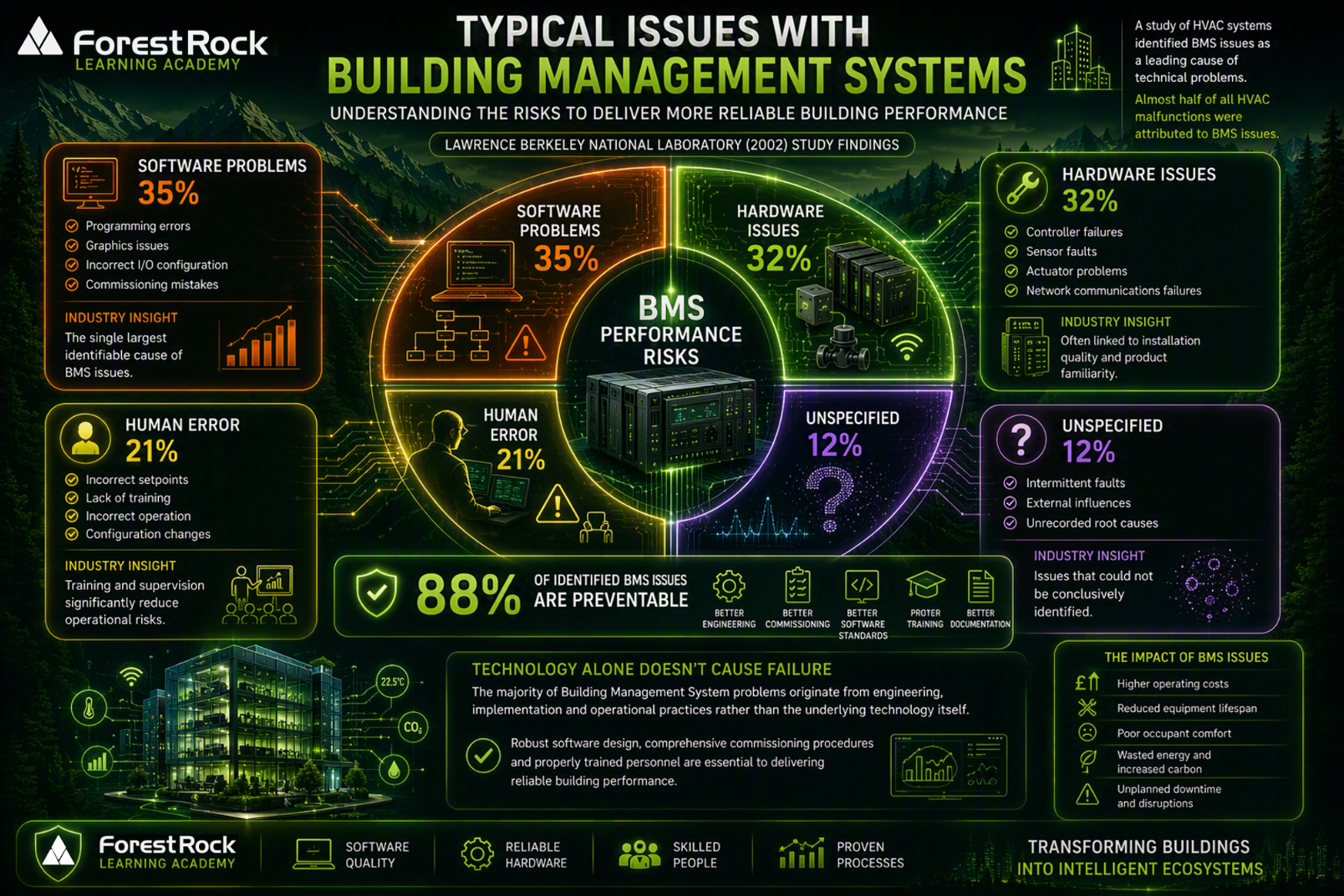
A study by Lawrence Berkley National Laboratory in 2002 pinpointed BMS as a primary source of technical problems in HVAC systems. The study revealed that about half of all HVAC malfunctions were linked to BMS issues. Hardware-related problems, such as controller malfunctions, field device issues, and communication breakdowns, accounted for 32% of these issues. Software-related troubles, including misconfigured inputs and outputs, programming errors, and graphics glitches, contributed to another 35%. Human error, such as incorrect setpoint values leading to equipment operating outside its intended parameters and lack of operator training, was responsible for 21% of the problems. The remaining 12% of issues were unspecified.
A visual breakdown of these statistics is provided below:
-
Hardware Issues: 32%
-
Software Problems: 35%
-
Human Error: 21%
-
Unspecified: 12%
Understanding the Findings
The chart above illustrates the most common causes of Building Management System (BMS) issues identified in HVAC installations. While hardware faults account for a significant proportion of problems, the results demonstrate that successful BMS projects depend just as much on good design, software quality, commissioning procedures, and user training as they do on the underlying technology.
Hardware-related issues often arise from incorrect product selection, installation challenges, communication network problems, or unfamiliarity with specific manufacturers' equipment.
Engaging experienced technical specialists during the design and specification stages can help ensure that the most appropriate products, protocols, and architectures are selected for the application.
Software-related issues represent the largest category of identified faults. These can include programming errors, incorrectly configured inputs and outputs, graphics issues, or control strategies that have not been fully tested under operating conditions. Adopting proven software standards, application templates, and structured engineering processes can significantly improve system reliability and consistency throughout the project lifecycle.
Human error remains another major contributor to system issues. Incorrect setpoints, configuration changes, insufficient documentation, and limited operator knowledge can all affect system performance. This highlights the importance of ongoing training for engineers, commissioning staff, facilities teams, and end users to ensure systems are operated and maintained effectively.
At Forest Rock, our Technical Sales Team works closely with customers during the design and specification phase to help select the right products, communication protocols, and system architecture for each application. Drawing on decades of industry experience, the team can provide guidance on interoperability, network design, controller selection, and future-proofing strategies to help reduce project risk from the outset.
In addition, the Forest Rock Learning Academy provides comprehensive training for controls engineers, system integrators, facilities managers, and end users. By combining practical experience with structured learning pathways, we help organisations develop the skills and knowledge needed to design, deploy, commission, operate, and maintain reliable Building Management Systems.
While some issues will always remain unpredictable, the vast majority of BMS-related problems can be reduced through sound engineering practices, robust software development standards, effective commissioning procedures, appropriate product selection, and ongoing professional training.
Key Takeaway
Technology alone does not guarantee success. Reliable Building Management Systems are built on the combination of the right products, the right design, the right software, and the right people.
Need assistance? Speak to the Forest Rock Technical Sales Team for guidance on product selection and system design, or explore the Forest Rock Learning Academy to develop the skills needed to deliver successful smart building projects.
If you need more help:
Then why not contact our sales or support team.

sales@forestrock.co.uk or support@forestrock.co.uk
Learn | Integrate | Innovate
Welcome to the Forest Rock Learning Academy.
Real Knowledge. Real Engineers. Real Solutions.