

A Practical Guide for Facilities Managers and Property Owners
By Paul Martin
Real Knowledge. Real Engineers. Real Solutions.
Introduction
Modern buildings are expected to do far more than simply provide heating, cooling and lighting.
Building owners need to reduce operating costs, facilities teams need greater visibility of building performance, occupants expect comfortable environments, and organisations face increasing pressure to meet sustainability and ESG targets.
The Building Management System (BMS) has evolved into the central platform that helps achieve all of these objectives.
Today, a modern Building Energy Management System (BEMS) can connect HVAC equipment, lighting systems, energy meters, renewable technologies, environmental sensors, analytics software and cloud platforms into a single operational environment.
Rather than managing multiple disconnected systems, facilities managers can gain real-time visibility of building performance from a single dashboard.
Why Building Management Systems Matter
A building's performance is determined not by how it was designed, but by how it operates every day.
Even highly efficient equipment can waste energy if it is poorly controlled, commissioned incorrectly, or operated inefficiently.
An effective BMS helps organisations to:
-
Reduce energy consumption
-
Improve occupant comfort
-
Identify maintenance issues early
-
Protect valuable assets
-
Reduce carbon emissions
-
Improve compliance reporting
-
Gain visibility across multiple sites
-
Support sustainability initiatives
For facilities managers, a good BMS provides information. A great BMS provides actionable insight.
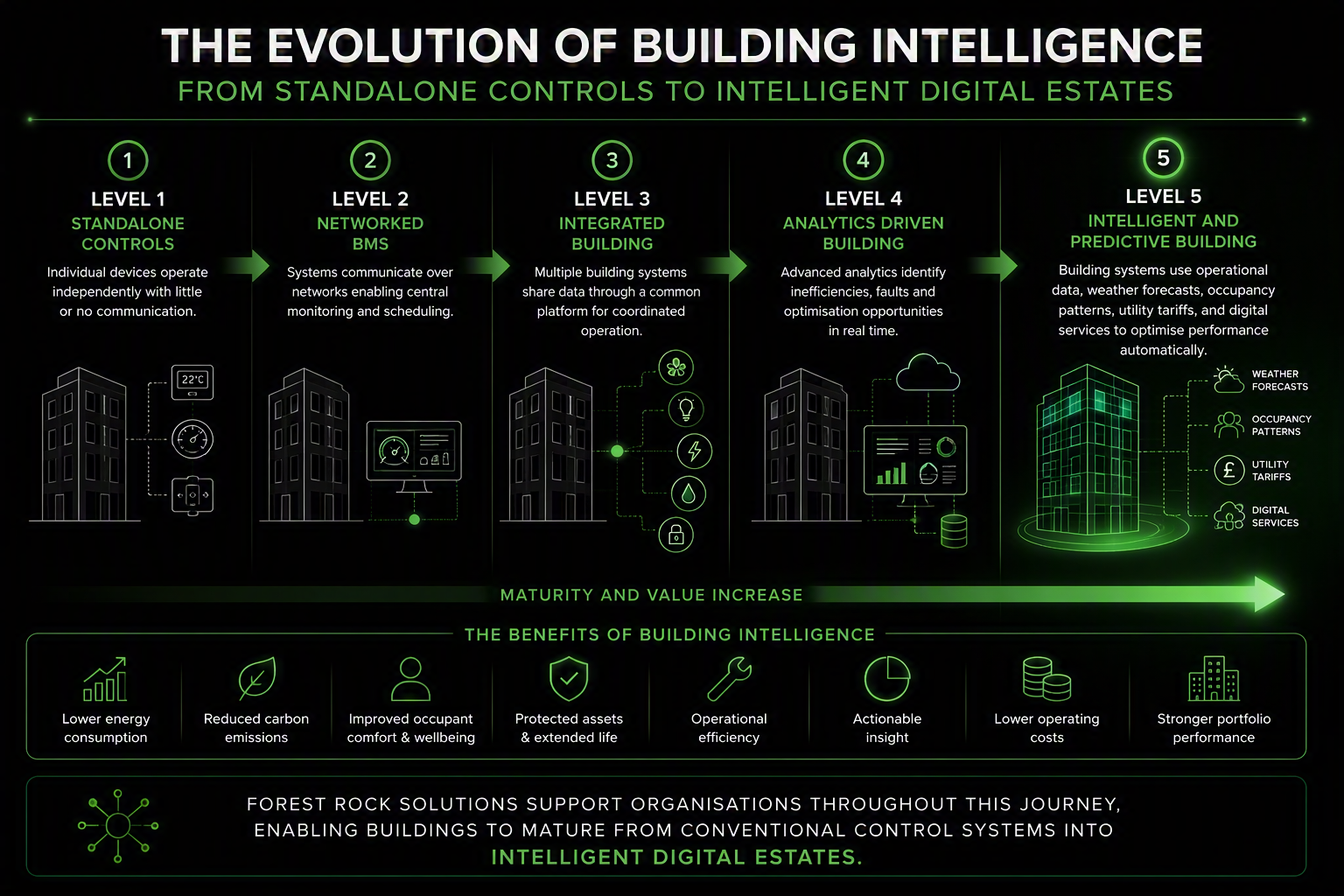
The Evolution of Smart Buildings
Building technology has changed significantly over the last twenty years.
Traditional Buildings
Older buildings often contain independent systems that operate separately:
-
Heating controls
-
Cooling systems
-
Lighting controls
-
Utility metering
-
Security systems
Information is fragmented and often difficult to access.
Connected Smart Buildings
Modern buildings integrate multiple systems onto a common platform.
Information flows between systems, allowing:
-
Better energy management
-
Improved occupant comfort
-
Easier maintenance
-
Faster fault identification
-
More efficient building operation
Intelligent Buildings
The latest generation of smart buildings use analytics and automation to continuously monitor performance and identify opportunities for optimisation.
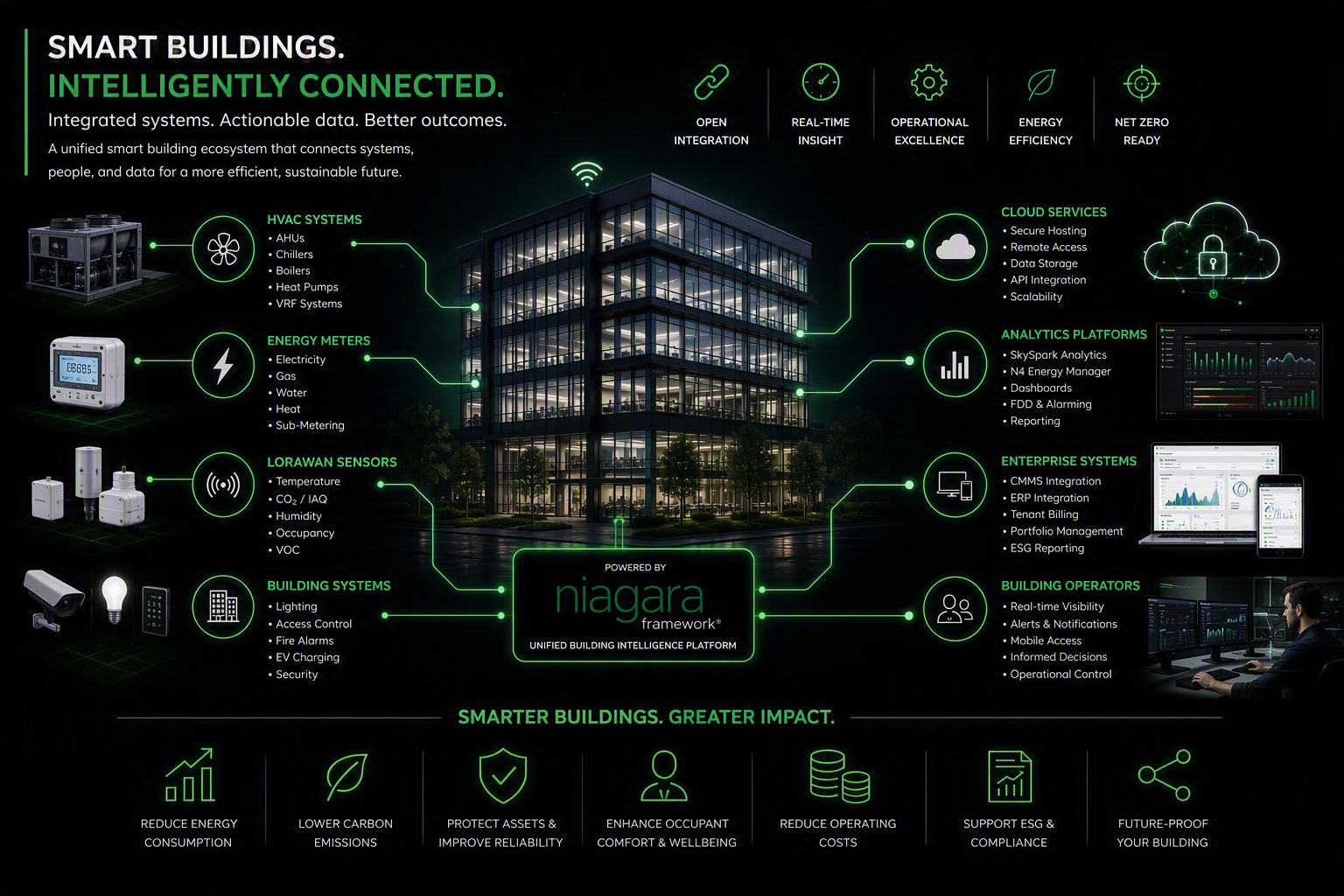
Creating a Connected Smart Building
Most commercial buildings contain numerous technologies that need to work together.
These may include:
-
HVAC systems
-
Lighting controls
-
Electricity meters
-
Heat networks
-
Renewable energy systems
-
EV chargers
-
Access control systems
-
Environmental Monitoring and Indoor Air Quality sensors
A modern BMS brings these technologies together into a single operational platform.
Real-World Benefits
Examples include:
-
Occupancy sensors reducing ventilation demand when rooms are empty
-
Meeting room bookings automatically adjusting temperature settings
-
EV chargers responding to electrical demand levels
-
Maintenance teams receiving alarms before equipment fails
-
Energy meters validating savings from improvement projects
The result is a smarter and more responsive building.
Figure 1: Smart Building Integration
Building Visibility and Operational Control
One of the greatest challenges for facilities teams is understanding what is happening across an estate.
Modern BMS platforms provide:
-
Real-time dashboards
-
Alarm management
-
Historical trends
-
Maintenance alerts
-
Occupancy insights
-
Energy performance monitoring
This allows teams to move from reactive maintenance to proactive management.
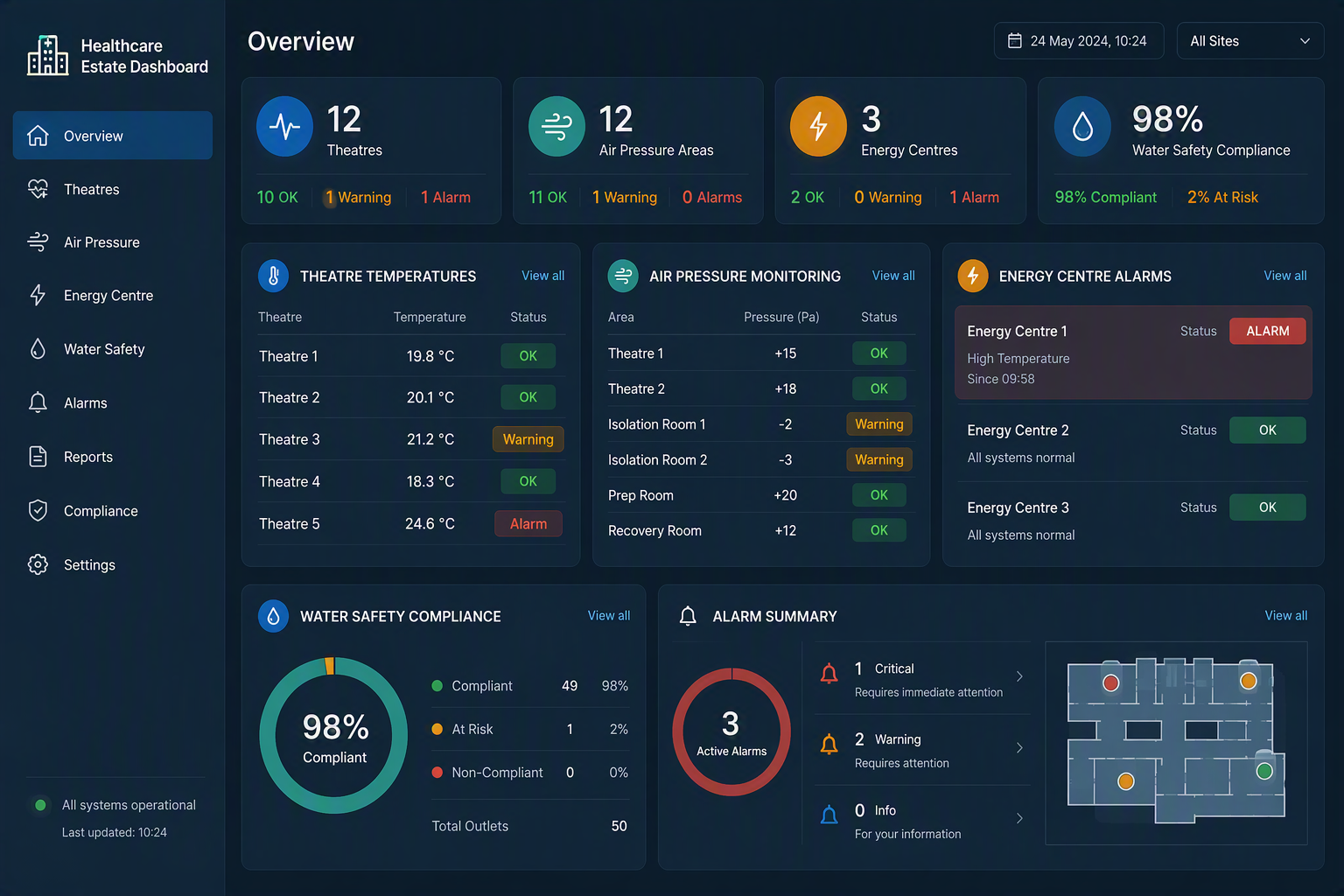
Healthcare and Critical Environments
Healthcare facilities place some of the most demanding requirements on building systems.
Modern smart building platforms can monitor and manage:
-
Theatre temperatures
-
Isolation room pressures
-
Critical ventilation systems
-
Energy centre performance
-
Water safety systems
-
Utility infrastructure
For NHS Trusts and healthcare providers, building systems have become business-critical operational tools.
Figure 2: Healthcare Estate Dashboard
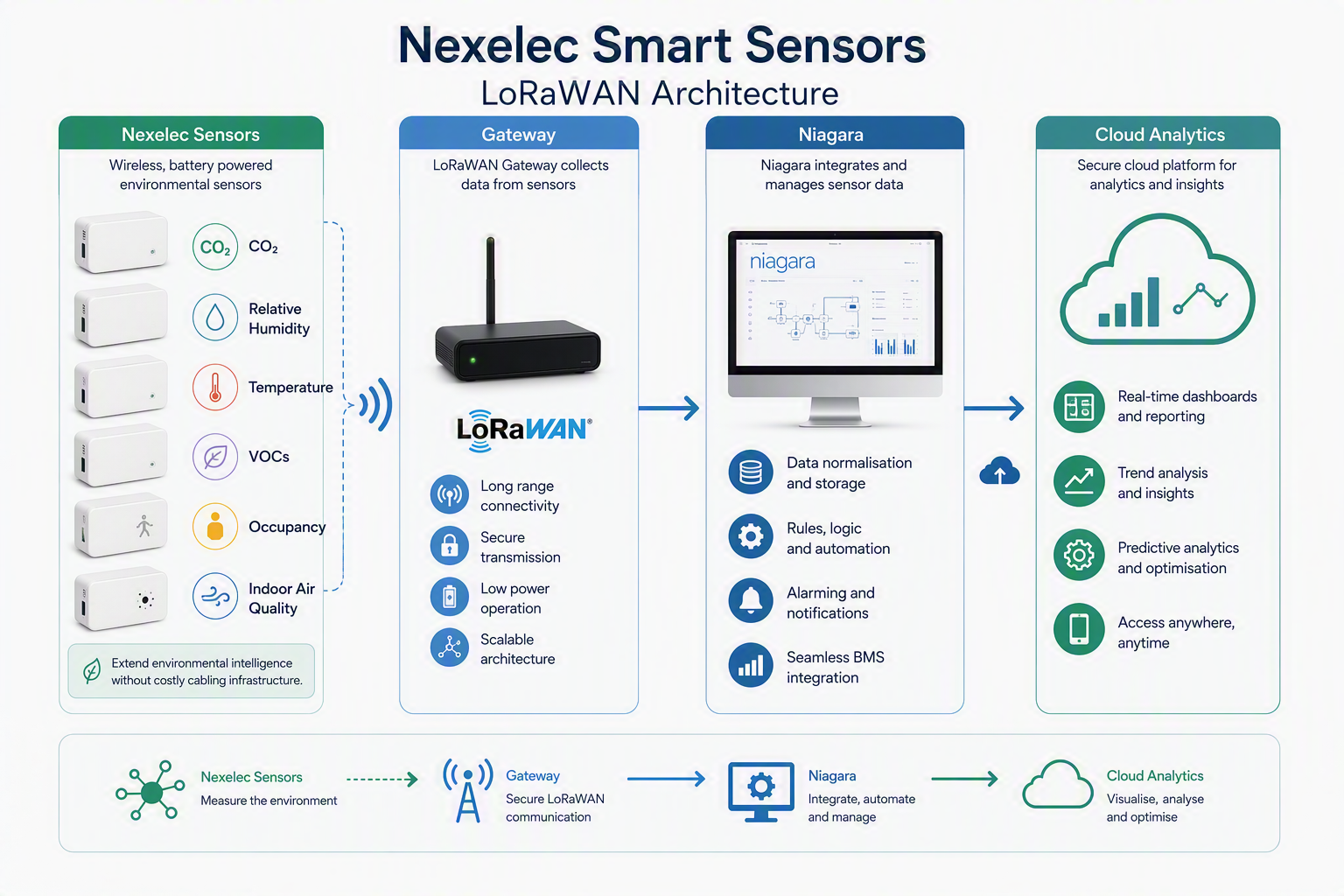
LoRaWAN and Wireless Building Intelligence
Installing new sensors in existing buildings can be expensive and disruptive.
LoRaWAN technology provides a cost-effective alternative by delivering long-range wireless communication with low power consumption.
Benefits include:
-
Reduced cabling costs
-
Faster installation
-
Easier retrofits
-
Long battery life
-
Simpler future expansion
Wireless monitoring allows facilities teams to gain new operational insights without major infrastructure works.
Environmental Monitoring and Indoor Air Quality
Modern wireless sensors can monitor:
-
Temperature
-
Relative humidity
-
CO₂
-
Occupancy
-
Volatile Organic Compounds (VOCs)
-
Indoor Air Quality (IAQ)
This helps maintain healthier indoor environments while supporting energy efficiency.
Figure 3: Wireless Sensor Architecture
Energy Management and Utility Monitoring
Reducing energy costs remains a priority for most organisations.
Modern building platforms can integrate:
-
Electricity meters
-
Gas meters
-
Water meters
-
Heat meters
-
Renewable generation systems
By collecting data automatically, facilities teams gain a clear understanding of where energy is being used and where savings can be made.
Common Energy Optimisation Strategies
Examples include:
-
Demand-controlled ventilation
-
Variable speed drives
-
Occupancy-based control
-
Weather compensation
-
Boiler optimisation
-
Chiller optimisation
-
Load shedding
-
Optimum start and stop
Depending on the building type, occupancy profile and existing controls strategy, these optimisation techniques can commonly reduce building energy consumption by 10-30% when properly implemented and maintained.
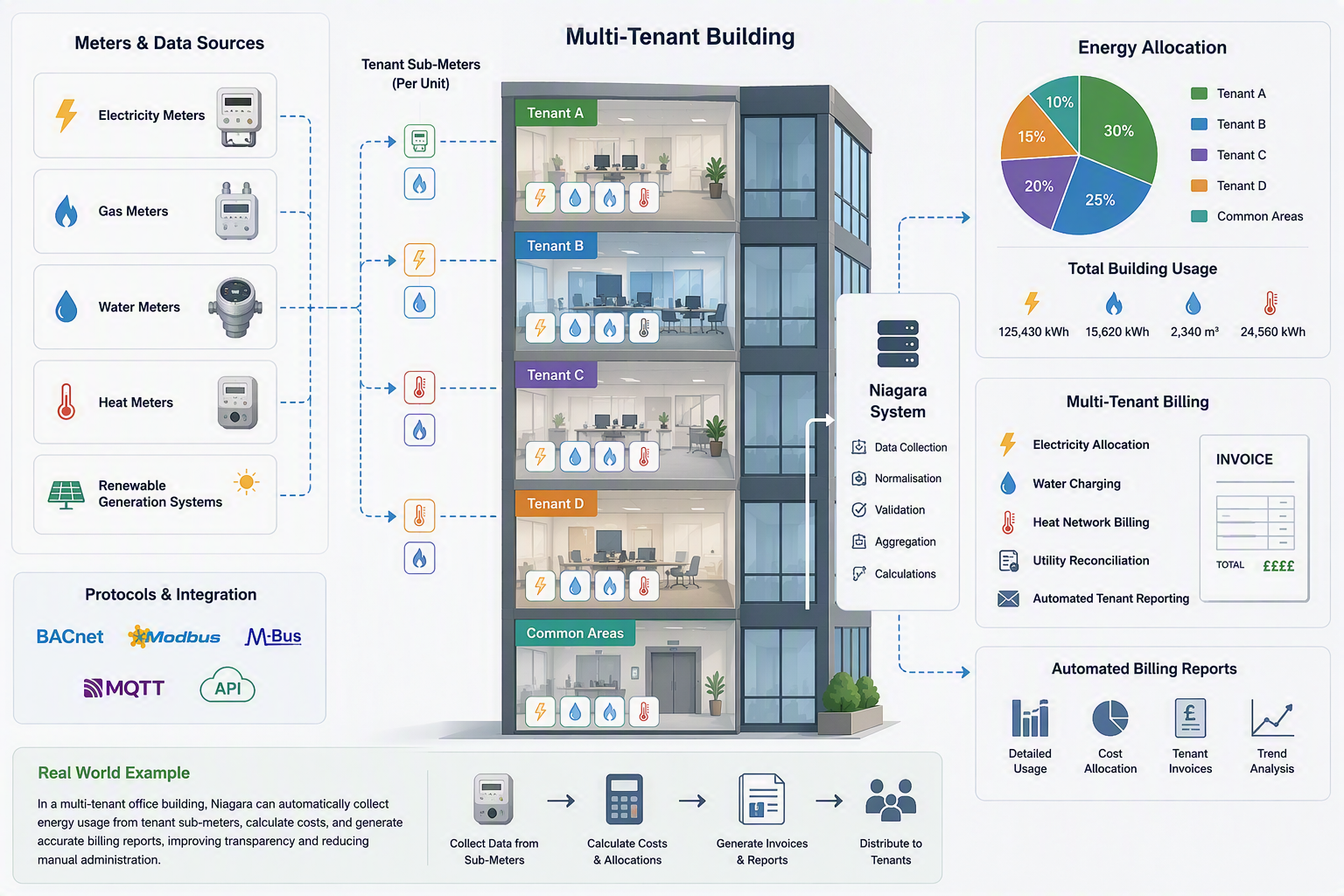
Multi-Tenant Billing and Utility Allocation
For landlords and property management companies, utility allocation can be time-consuming and complex.
Modern smart building platforms can automate:
-
Electricity charging
-
Water charging
-
Heat network billing
-
Utility reconciliation
-
Tenant reporting
This improves transparency while reducing administration.
Example
In a multi-tenant office building, energy consumption from each tenant area can be collected automatically and converted into billing reports without manual intervention.
Figure 4: Multi-Tenant Billing Diagram
Open Protocols and Future-Proofing
Modern building owners increasingly require systems that avoid vendor lock-in. Open protocols such as:
-
BACnet
-
Modbus
-
MQTT
-
KNX
-
LoRaWAN
-
OPC-UA
allow organisations to integrate systems from multiple manufacturers while retaining flexibility for future expansion.
Modern building platforms increasingly integrate with digital twins, enterprise data platforms and AI-assisted analytics to provide deeper operational insights and support data-driven decision-making.
Estate-Wide Property Management
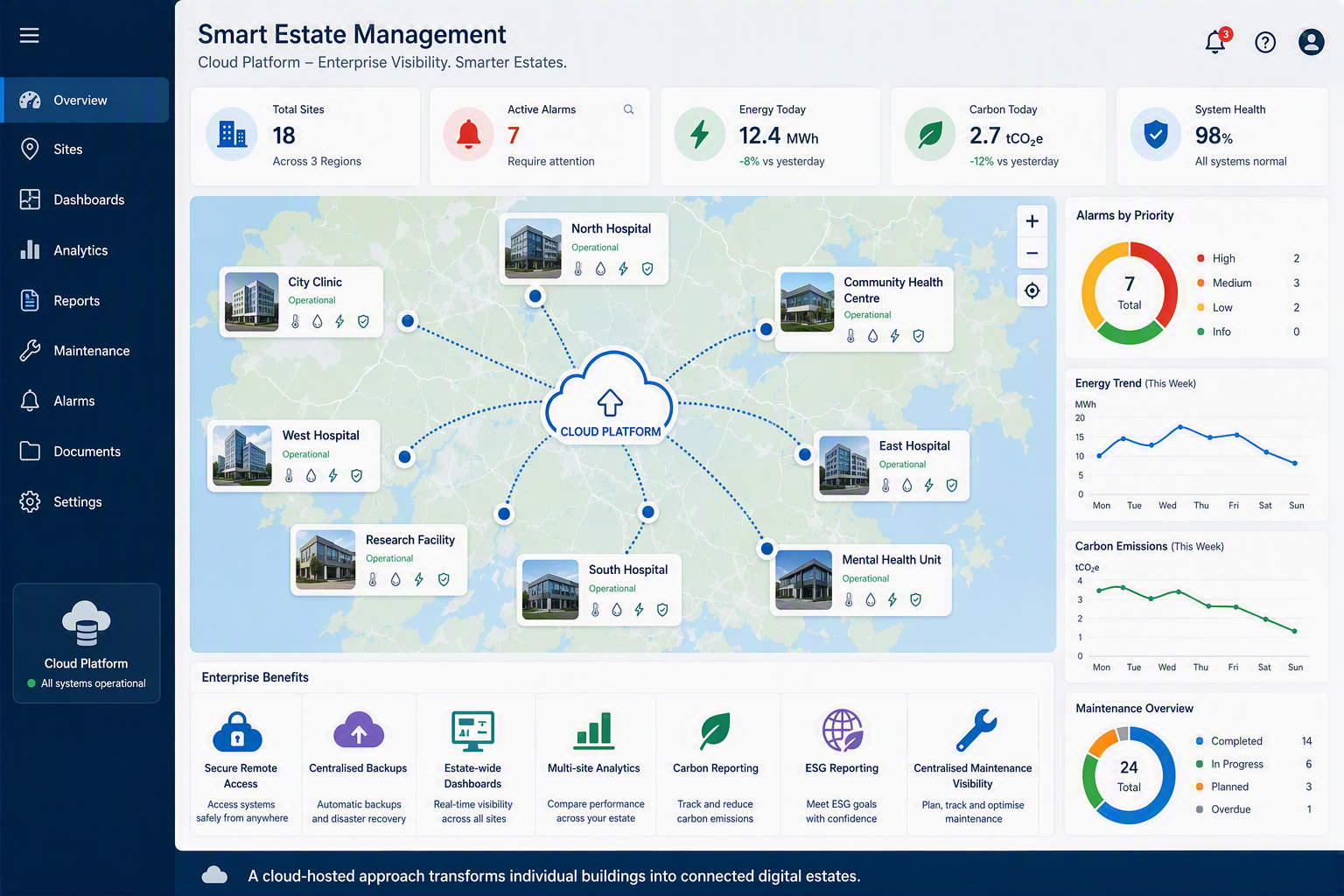
Many organisations now manage multiple buildings across different locations.
A cloud-based building management platform enables:
-
Centralised monitoring
-
Estate-wide dashboards
-
Cross-site alarm management
-
Energy benchmarking
-
Carbon reporting
-
Building comparison
This creates a unified view of building performance across an entire portfolio.
Suitable for:
-
NHS Trusts
-
Universities
-
Commercial property portfolios
-
Retail estates
-
Property management companies
Figure 5: Estate Management Dashboard
Continuous Improvement Through Analytics
Collecting data is only the first step.
The greatest value comes from understanding what that data means.
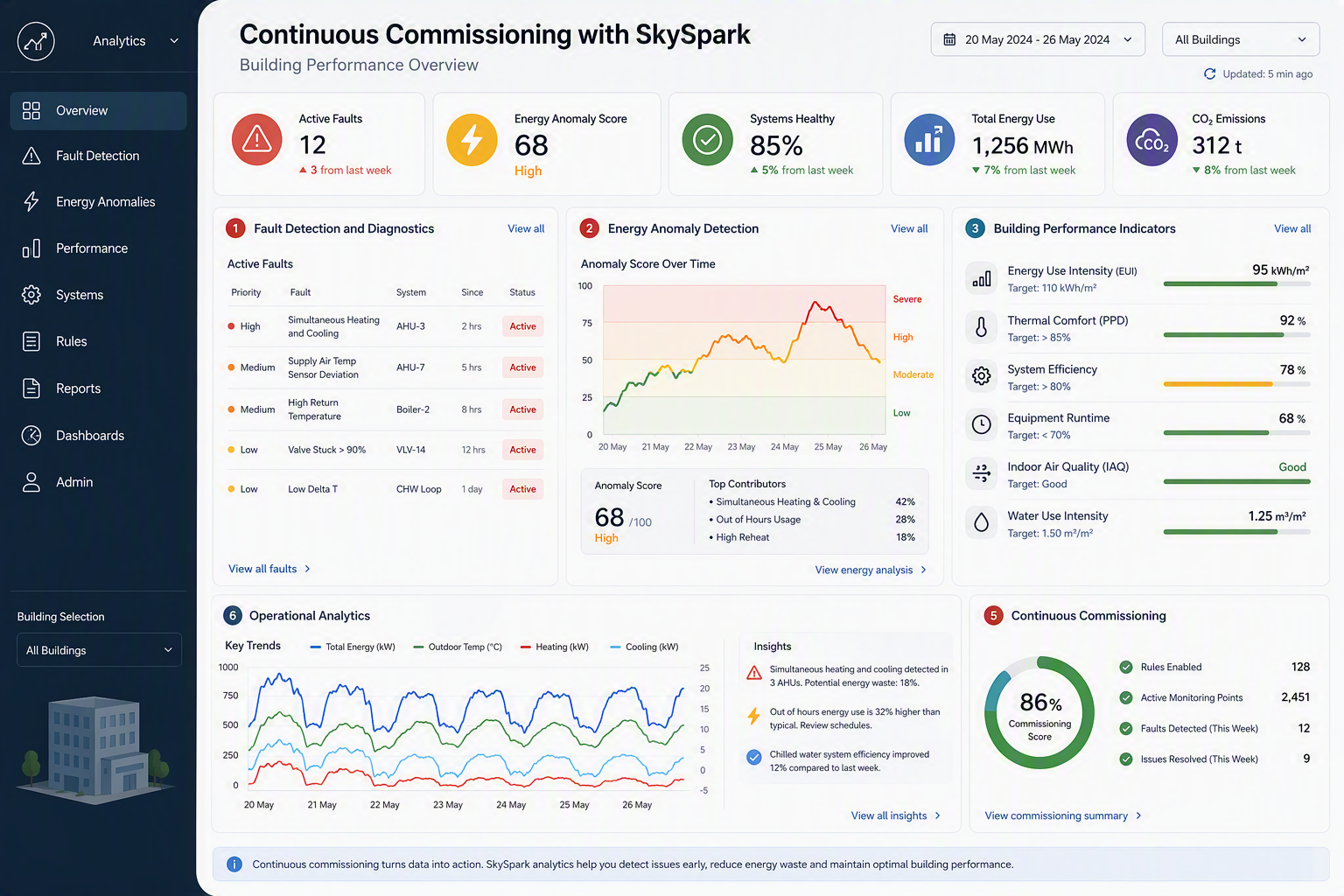
Analytics platforms continuously review building performance and identify problems that may otherwise go unnoticed.
Typical examples include:
-
Simultaneous heating and cooling
-
Excessive energy consumption
-
Sensor failures
-
Valve performance issues
-
Equipment running outside normal hours
Rather than waiting for complaints or utility bills, continuous analytics can identify hidden faults that may otherwise remain undetected for months, helping prevent unnecessary energy consumption and equipment wear.
Figure 6: Building Analytics Dashboard
Sustainability and ESG Reporting
Building systems now play an important role in sustainability programmes.
A modern BMS can support:
-
Energy reduction initiatives
-
Carbon reporting
-
ESG reporting
-
Net Zero programmes
-
Building certification schemes
Reliable operational data provides evidence for sustainability reporting and helps organisations measure progress over time.
Protecting Assets and Improving Reliability
Building services equipment represents a significant investment.
A BMS helps protect those assets through:
-
Frost protection
-
Pump exercise routines
-
Valve exercise routines
-
Runtime balancing
-
Alarm escalation
-
Predictive maintenance insights
These features improve system reliability while extending equipment life.
Typical Benefits Achieved
Organisations implementing modern building management solutions commonly experience improvements in:
-
Energy efficiency
-
Carbon reduction
-
Occupant satisfaction
-
Maintenance productivity
-
Utility transparency
-
Asset reliability
-
Estate-wide visibility
-
Reporting efficiency
The real value of a BMS is not the technology itself, but the operational and financial benefits it delivers.
Typical Customer Outcomes
Facilities teams commonly use modern BMS platforms to:
-
Improve operational visibility
-
Reduce energy waste
-
Simplify utility reporting
-
Improve maintenance response
-
Support sustainability targets
-
Extend asset life
Cyber Security and Secure Remote Access
Modern building systems should support:
-
Secure remote access
-
Role-based permissions
-
Encrypted communications
-
Network segregation
-
Centralised backup strategies
Increasingly, cyber security is as important as energy efficiency when selecting a building management platform.
Conclusion
Building Management Systems have evolved into powerful operational platforms that support comfort, sustainability, energy efficiency, compliance and asset protection.
By integrating building services, environmental monitoring, indoor air quality monitoring, utility metering, analytics and cloud technologies into a single platform, organisations can gain complete visibility of their buildings and make better-informed decisions.
For facilities managers and property owners, the objective is straightforward:
-
Lower operating costs
-
Better occupant experiences
-
Improved sustainability performance
-
Reduced risk
-
More efficient estate management
An intelligent building is no longer a future concept. It is a practical tool for operating buildings more effectively today.
Why Choose Forest Rock?
Forest Rock helps organisations gain greater visibility of building performance, reduce energy waste, improve asset reliability and deliver smarter estate management through open, future-proof building technologies.
-
Tridium Niagara Framework
-
iSMA CONTROLLI controllers
-
Phoenix Contact Niagara controllers
-
LoRaWAN wireless technology
-
Environmental Monitoring and Indoor Air Quality sensors
-
N4 Energy Manager
-
SkySpark analytics
-
Enterprise cloud platforms
The result is improved operational efficiency, lower energy costs and better decision-making.
For over two decades, Forest Rock has worked alongside its partners, providing the products, expertise, and technical support needed to successfully deliver open building integration and smart building solutions across healthcare, education, commercial property, and critical infrastructure environments.

Are you getting the visibility and operational insight you need from your buildings?
Talk to Forest Rock
Whether you are planning a BMS upgrade, implementing metering, deploying wireless sensors or improving estate-wide visibility, Forest Rock can help.
Contact us to discuss:
-
Building Management Systems
-
Energy Monitoring
-
Smart Building Analytics
-
Tenant Billing
-
Cloud-Hosted Niagara Solutions
-
LoRaWAN Sensor Deployments
-
Estate-Wide Management Platforms
sales@forestrock.co.uk
support@forestrock.co.uk
Learn | Integrate | Innovate
Welcome to the Forest Rock Learning Academy.
Real Knowledge. Real Engineers. Real Solutions.