

Introduction
Buildings today generate more operational data than ever before, yet many still consume significantly more energy than predicted at design stage. The challenge is no longer installing efficient equipment. It is transforming data into decisions that improve performance every day.
Heat pumps, high-efficiency boilers, variable-speed drives, intelligent lighting systems, renewable technologies and advanced HVAC equipment are now commonplace across commercial and public-sector estates. Yet despite significant investment in technology, many buildings still fail to achieve their expected levels of energy efficiency, comfort and operational performance.
The challenge is not usually the equipment itself.
The challenge is ensuring every system works together intelligently.
Effective building controls and open integration have become the key factors that determine whether a building achieves its design objectives or becomes another example of the industry's well-known performance gap.
Bridging the Gap Between Design and Reality
Across the building services industry, there is growing recognition that building performance is often determined long after practical completion.
A building may be designed to achieve ambitious carbon reduction targets, but once occupied, energy consumption can increase significantly due to poorly coordinated controls, inadequate commissioning, limited visibility of system performance and a lack of ongoing optimisation.
Even the most efficient HVAC plant cannot achieve its full potential without effective control.
A modern Building Management System (BMS) helps address this challenge by:
-
Coordinating plant operation
-
Optimising energy use
-
Monitoring performance
-
Detecting faults
-
Supporting maintenance teams
-
Protecting critical assets
-
Providing meaningful operational data
-
Enabling continuous commissioning
Ultimately, the true measure of a building's performance is not how it was designed, but how it operates every day.
Figure 1: Smart Building Architecture.
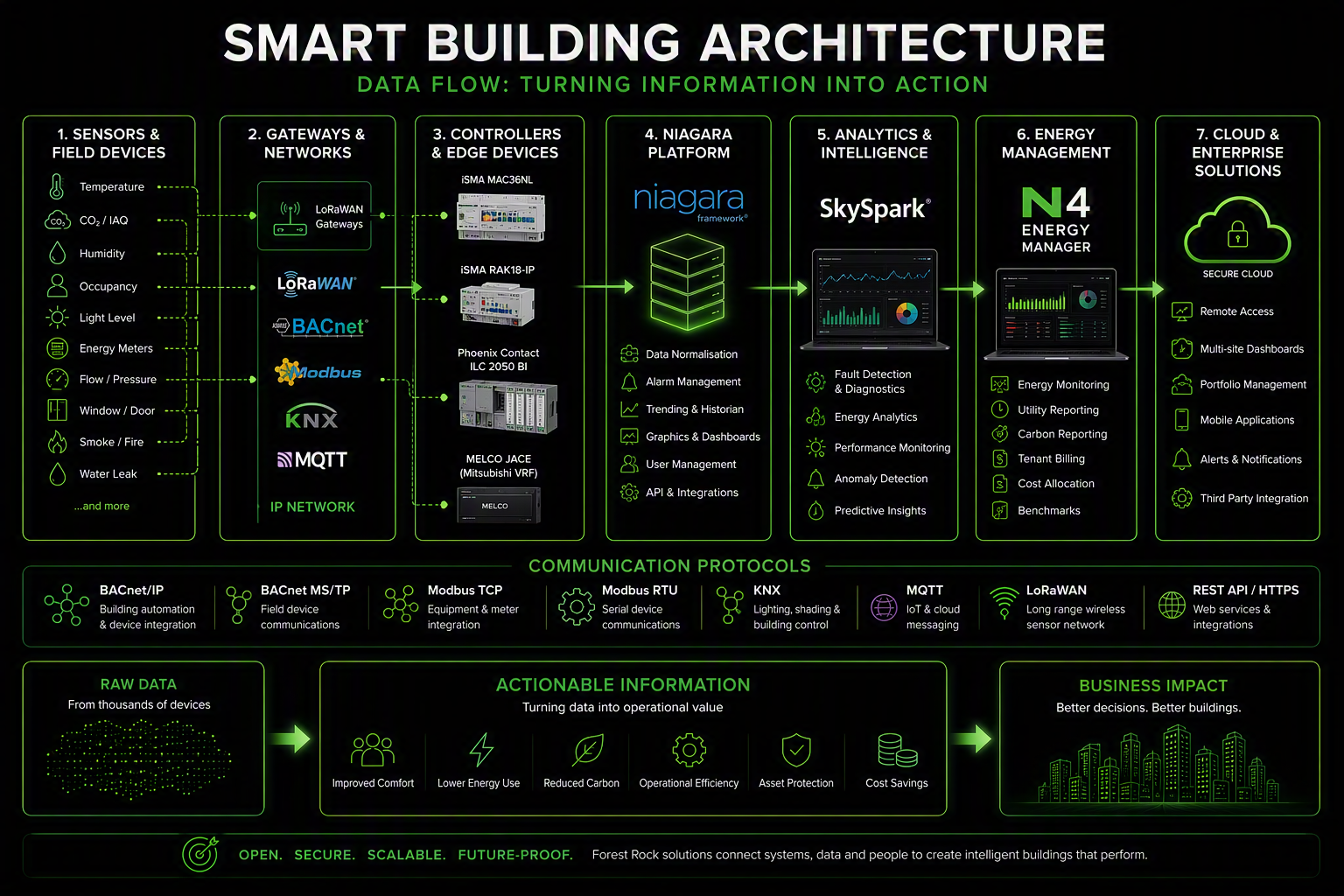
Data flows from sensors and building systems through open protocols and edge controllers into the Niagara Framework, creating actionable intelligence that improves comfort, efficiency and operational performance.
Building Systems Should Cooperate, Not Compete
Historically, building systems operated independently.
HVAC systems controlled heating and cooling.
Lighting systems managed illumination.
Energy meters recorded consumption.
Security systems monitored access.
Each system generated valuable information, but very little of that information was shared.
Modern smart buildings take a fundamentally different approach.
Through open integration technologies such as BACnet, Modbus, KNX, MQTT, LoRaWAN and REST APIs, previously isolated systems can exchange information and work together as part of a single intelligent architecture.
This integration may include:
-
HVAC systems
-
Lighting controls
-
Renewable energy technologies
-
Energy metering
-
Power monitoring
-
Heat networks
-
Access control systems
-
EV charging infrastructure
-
Security platforms
-
IoT sensor networks
-
Enterprise software applications
When systems communicate effectively, buildings become far more responsive and efficient.
Examples include:
-
Occupancy sensors reducing ventilation demand in unused areas.
-
Meeting room booking systems automatically adjusting HVAC schedules.
-
EV chargers responding to changing building electrical loads.
-
Energy meters validating optimisation projects and savings initiatives.
-
Maintenance systems generating work orders automatically when faults occur.
In this environment, the Building Management System becomes the central nervous system of the building.
Turning Data Into Operational Intelligence
Modern buildings generate vast quantities of information every second.
Temperature sensors, CO₂ monitors, flow meters, electricity meters, occupancy sensors and environmental monitoring devices all contribute data that can support better decision-making.
The challenge is not collecting data.
The challenge is transforming data into actionable information.
Modern Niagara-based architectures achieve this by creating a structured flow of information across multiple layers:
Sensors and Field Devices
Data originates from a diverse range of field devices including environmental sensors, occupancy monitoring systems, energy meters and plant instrumentation distributed throughout the building.
Open Communications
Open communications form the backbone of the platform, enabling data exchange through widely adopted industry standards including BACnet/IP, BACnet MS/TP, Modbus TCP, Modbus RTU, KNX, MQTT, LoRaWAN and REST APIs. This open, standards-based approach ensures interoperability across manufacturers and technologies, allowing building owners to integrate, monitor and optimise systems through a single environment while retaining the flexibility to expand and adapt their building infrastructure in the future.
Controllers and Edge Devices
Local automation is provided by intelligent edge controllers that manage equipment operation while forwarding data to supervisory systems.
Niagara Framework
At the heart of the architecture is the Niagara Framework, which serves as a unified integration and management layer for the entire building ecosystem. By bringing together data from multiple systems and protocols, Niagara provides data normalisation, alarm management, historical trending, visualisation, user administration and analytics integration within a single platform. Its open architecture and extensive API connectivity enable seamless interaction with third-party applications, supporting both operational management and enterprise-level analytics. The result is a consistent, estate-wide operational view that enables engineering teams to monitor performance, identify issues and make informed decisions from a single source of truth.
Figure 2: Forest Rock Niagara Product Ecosystem.
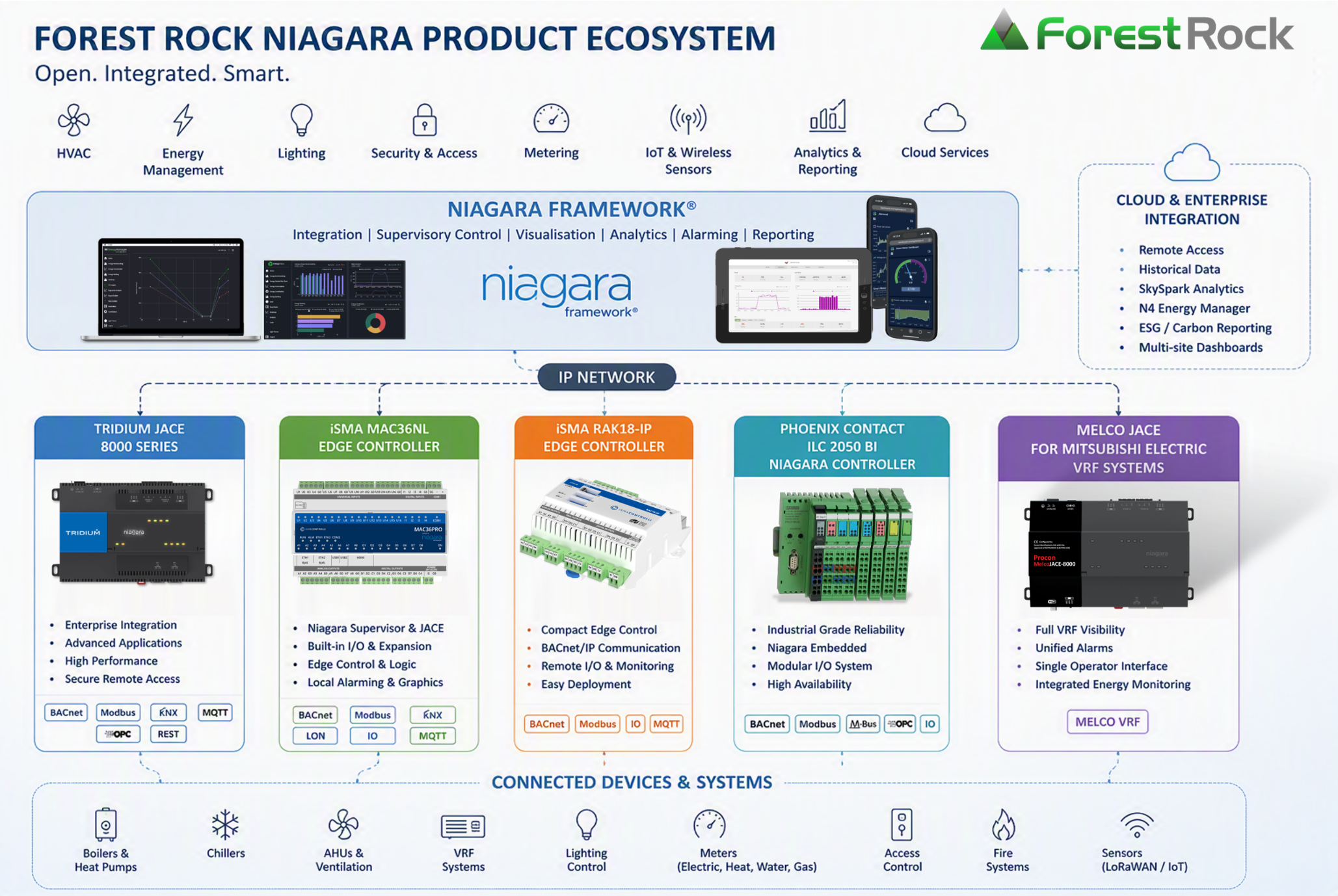
Open integration architecture built around Niagara Framework, connecting edge controllers, supervisory systems and enterprise applications into a unified smart building platform.
Forest Rock's Open Smart Building Ecosystem
Forest Rock delivers a portfolio of Niagara-based technologies designed to support open, scalable and future-ready building architectures.
Enterprise Integration and Supervision
The Tridium JACE provides open integration, supervisory control, alarm management, historical trending and enterprise visualisation for multi-vendor building systems.
The JACE serves as the integration hub between disparate building systems.
Plantroom Automation
The iSMA MAC36NL combines Niagara functionality with programmable automation and onboard I/O.
Typical applications include:
-
Boiler plantrooms
-
Air handling units
-
Energy centres
-
Heat pump systems
-
Building automation panels
The controller delivers both local automation and enterprise integration from a single device.
Critical Infrastructure
Designed for demanding environments, the Phoenix Contact ILC 2050 BI combines industrial automation reliability with Niagara integration.
Ideal applications include:
-
Hospitals
-
Critical infrastructure
-
Utility monitoring
-
District heating networks
-
Large energy centres
Remote Monitoring
The RAK18-IP extends automation and monitoring capabilities to distributed plant and remote assets.
Applications include:
-
Metering networks
-
Energy monitoring projects
-
Small automation systems
-
Remote plantrooms
VRF Integration
Designed specifically for Mitsubishi Electric VRF systems, the MELCO JACE provides:
-
Complete VRF visibility
-
Unified alarm management
-
Integrated energy monitoring
-
Single operator interface
This allows VRF assets to be managed alongside other building services from a common platform.
Energy Efficiency Starts With Control
Many organisations focus on plant efficiency when reducing energy costs.
However, controls strategy often has a greater impact on operational performance than equipment selection alone.
Effective control strategies can significantly reduce energy consumption while maintaining occupant comfort and asset reliability.
These strategies include:
-
Variable-speed drives
-
Boiler sequencing
-
Chiller optimisation
-
Demand-controlled ventilation
-
Occupancy-based control
-
Heating and cooling interlocks
-
Optimum start and stop
-
Weather compensation
-
Load shedding
-
Continuous commissioning
Together, these techniques help buildings reduce energy use, lower operating costs and support wider sustainability objectives.
Figure 3: Ten Key Energy Saving Strategies.
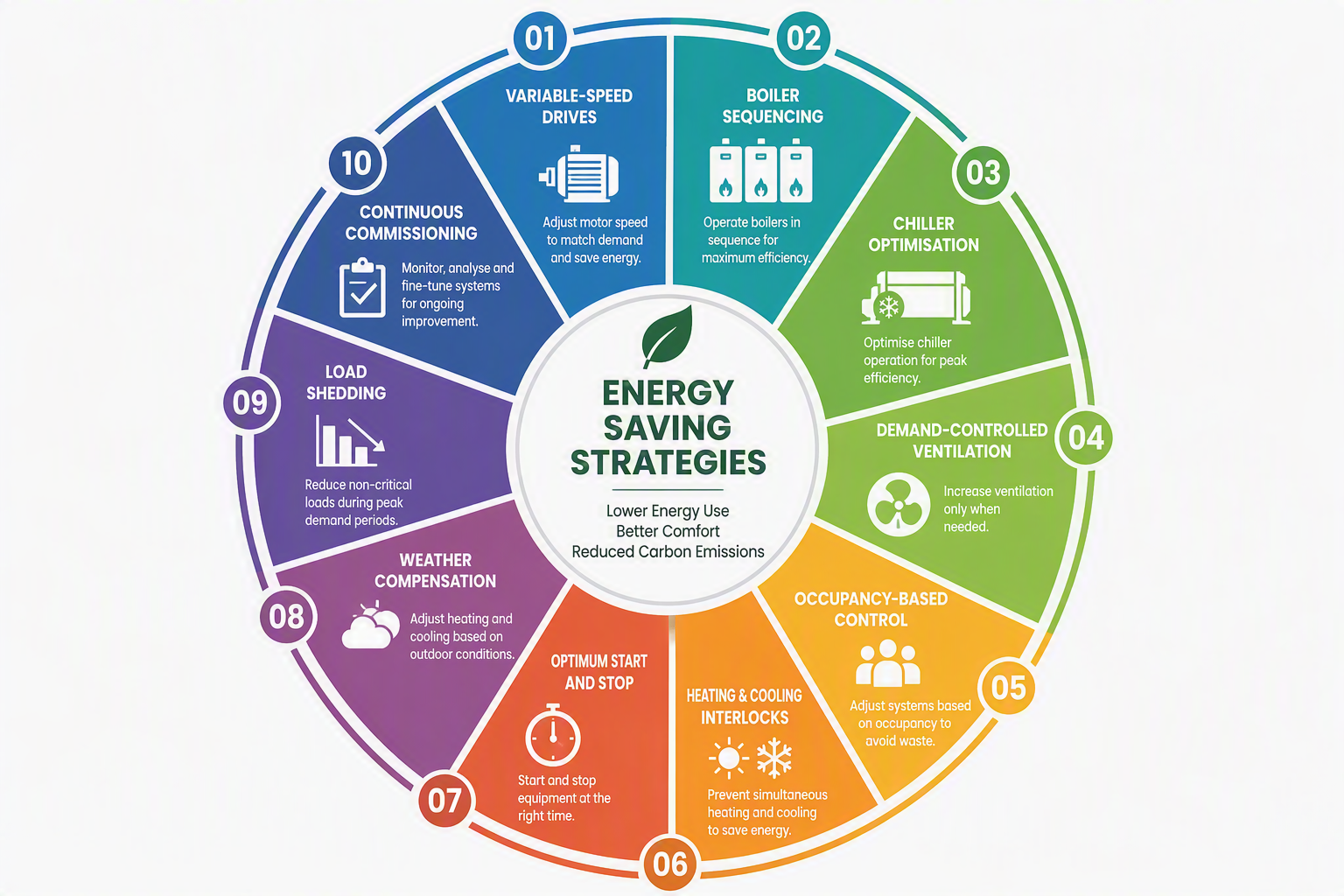
Intelligent control techniques used within modern Building Management Systems to reduce energy consumption, improve occupant comfort and lower carbon emissions.
Building Performance Is a Journey, Not a Project
One of the biggest misconceptions in building automation is that performance is achieved at handover. In reality, commissioning is only the beginning of the journey.
A building may be designed with ambitious energy targets, advanced HVAC systems and sophisticated control strategies, but long-term success depends on what happens after occupancy. As operational requirements change, spaces are reconfigured, and equipment ages, building performance can gradually drift away from the original design intent.
This is why leading organisations now view building performance as a continuous lifecycle rather than a one-time project. Effective Building Management Systems provide the visibility needed to monitor performance, validate outcomes and identify opportunities for improvement throughout the life of the asset.
By combining real-time monitoring, historical trending, analytics and continuous commissioning, building operators can make informed decisions that improve efficiency, enhance occupant comfort and extend asset life.
The most successful buildings are not simply designed well. They are continuously measured, reviewed and optimised to ensure that performance objectives remain aligned with operational needs.
Figure 4: Building Performance Lifecycle
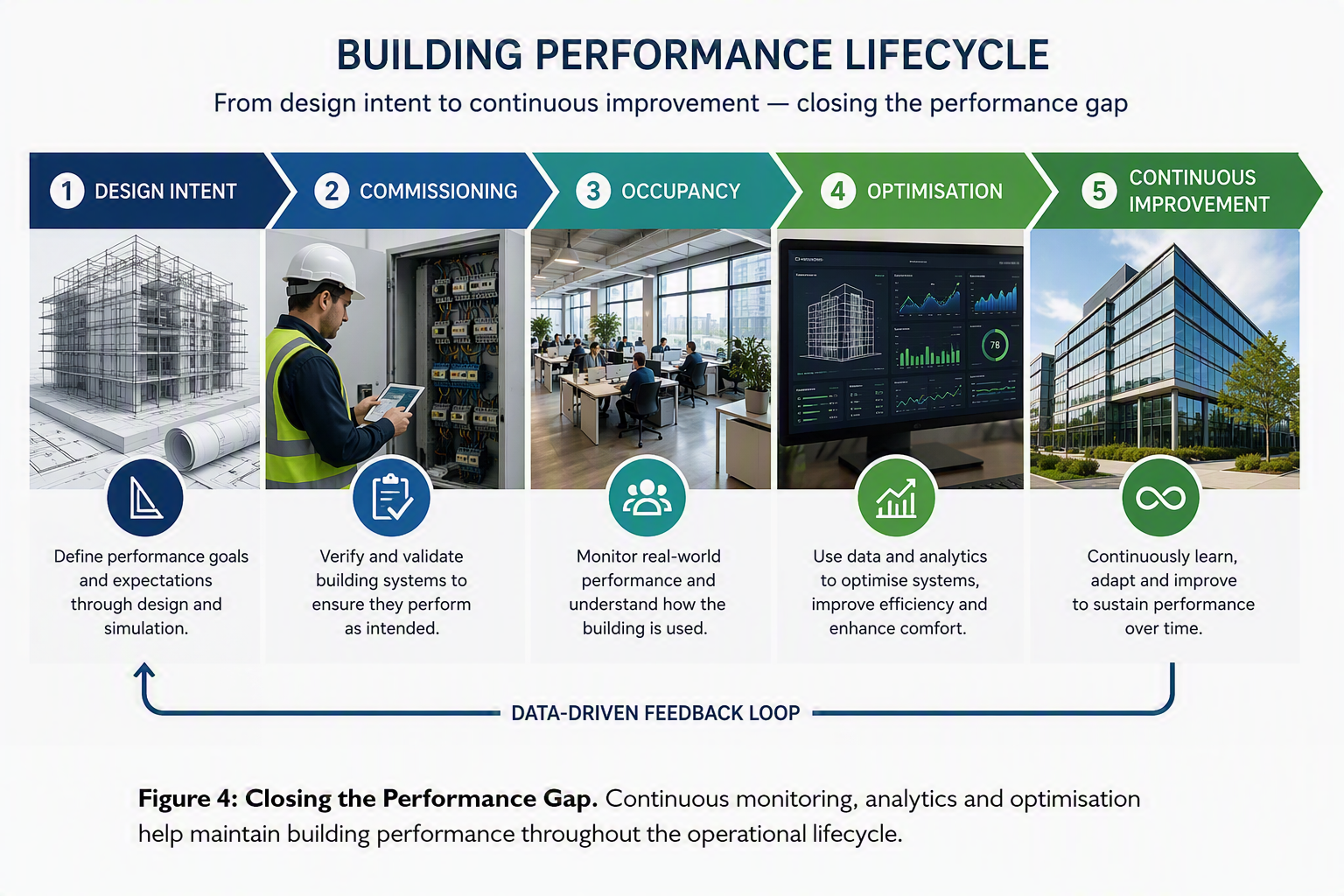
Building Performance Lifecycle. From design intent through commissioning, occupancy and optimisation, maintaining building performance requires continuous monitoring, feedback and improvement. Data-driven decision-making helps ensure buildings continue to deliver their intended energy, comfort and sustainability outcomes throughout their operational lifecycle.
The True Measure of a Building's Performance
Design models, energy simulations and commissioning activities establish performance expectations for a building during its design and construction phases. The challenge is ensuring those performance levels are maintained once the building enters day-to-day operation.
Following occupancy, real-world conditions inevitably begin to diverge from the assumptions made in the original performance brief. Occupancy patterns change, open-plan spaces are subdivided into offices or quiet areas, equipment is relocated or reconfigured, sensors drift out of calibration or become poorly positioned following layout changes, and operational requirements evolve over time. These seemingly minor changes can have a significant impact on building performance.
This creates what is commonly known as the performance gap: the difference between predicted building performance and actual operational performance. As the gap widens, buildings typically experience increased energy consumption, higher operating costs, reduced occupant comfort and greater carbon emissions.
While traditional commissioning provides an important starting point, maintaining performance throughout the building lifecycle requires a continuous approach. Modern Building Management Systems (BMS), combined with analytics, fault detection and diagnostics (FDD), and ongoing optimisation, provide the visibility needed to identify inefficiencies before they become significant problems.
By continuously monitoring building operation, engineering teams can detect performance drift, validate operation against design intent and implement corrective actions. Continuous commissioning and optimisation help ensure that buildings continue to deliver the efficiency, comfort and sustainability outcomes they were originally designed to achieve.
Figure 5: The Building Performance Gap.
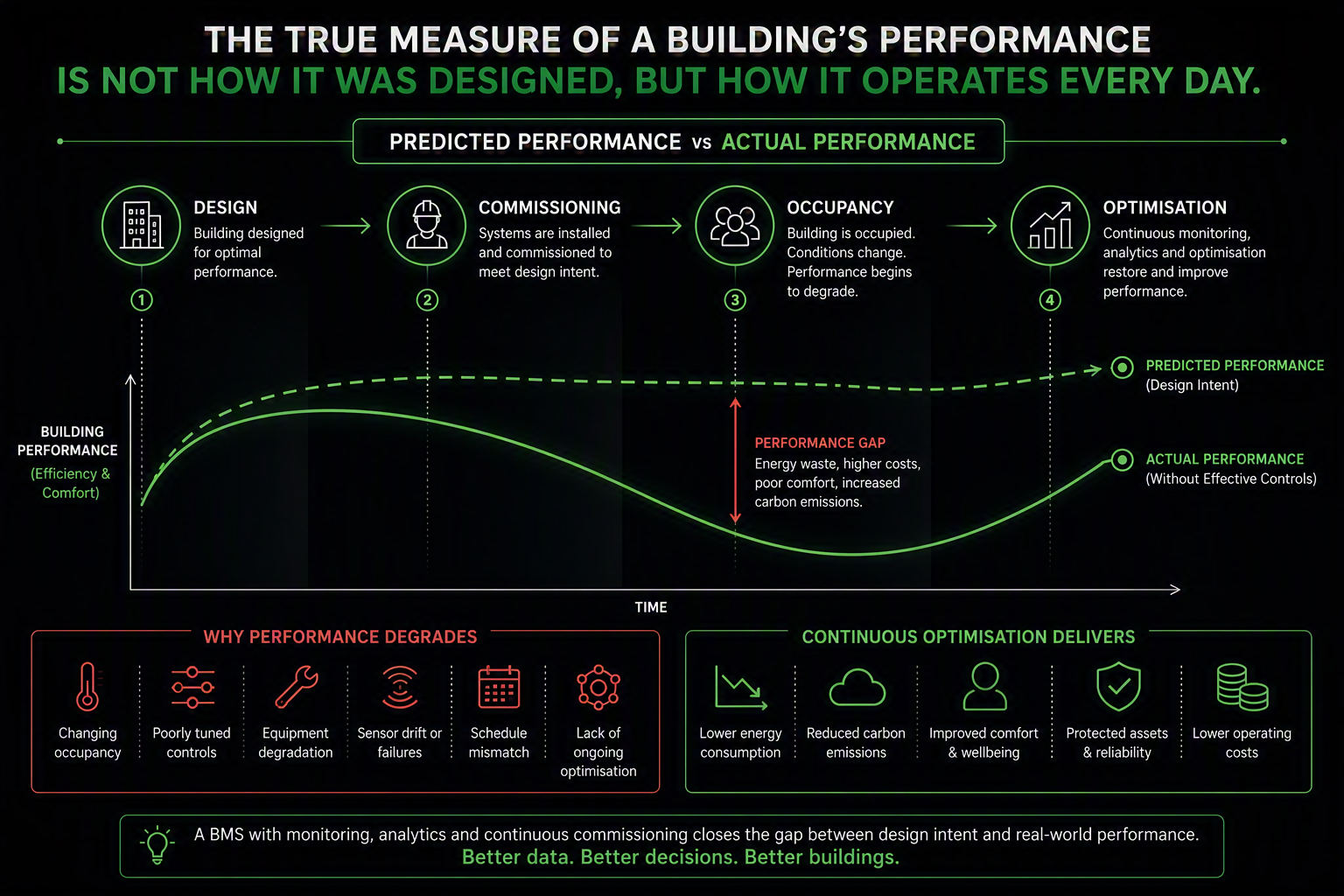
Predicted building performance often diverges from actual operational performance over time due to changing occupancy patterns, equipment degradation, control issues and operational drift. Continuous monitoring, analytics and optimisation help close this gap and maintain efficiency, comfort and sustainability outcomes.
Industry studies have consistently identified a performance gap between predicted and actual building energy consumption, with operational factors often responsible for significant variance from design expectations.
Continuous commissioning programmes can often identify significant energy-saving opportunities.
Operational Outcomes That Matter
Successful building automation projects are ultimately measured by operational outcomes rather than technology alone. When building systems are integrated and continuously optimised, organisations typically benefit from:
-
Lower energy costs
-
Reduced carbon emissions
-
Improved occupant comfort
-
Faster fault identification
-
Increased maintenance efficiency
-
Better utilisation of estate assets
-
Improved ESG reporting
-
Greater resilience of critical building services
For estates teams, the goal is not simply collecting more data. The goal is using the right data to make better operational decisions. In an increasingly complex built environment, organisations that transform operational data into actionable intelligence will be best placed to reduce energy consumption, meet sustainability targets and create better experiences for occupants.
Example Operational Insight
A hospital energy centre may operate exactly as commissioned while consuming more energy than expected. Trending can reveal boilers running against heat pumps, simultaneous heating and cooling, or ventilation systems operating during low occupancy periods. Identifying and correcting these issues can often deliver substantial energy savings without replacing any plant equipment.
Delivering Real Performance
The real measure of a smart building is not what it was designed to achieve, but what it continues to deliver. Continuous visibility, actionable insights and expert support help ensure building performance remains aligned with operational objectives long after handover.
By transforming operational data into informed decisions, organisations can close the performance gap, improve energy efficiency and create buildings that remain resilient, sustainable and efficient throughout their lifecycle.

sales@forestrock.co.uk
support@forestrock.co.uk
Learn | Integrate | Innovate
Welcome to the Forest Rock Learning Academy.
Real Knowledge. Real Engineers. Real Solutions.